




A Cotton Conveying Blower is responsible for moving loose cotton, recycled fiber, and other lightweight textile materials between different stages of a production line. Although pneumatic conveying may look simple, cotton fiber is much more difficult to transport than pellets, granules, or other free-flowing materials. Fibers are light, bulky, flexible, and capable of forming bridges, clusters, or deposits inside the pipeline.
When a conveying system begins to block, the blower itself is not always the real cause. Air volume, pressure, pipe diameter, bends, conveying distance, fiber density, moisture, dust level, and upstream feeding conditions can all influence how the fiber moves through the system. Understanding these factors is more useful than simply increasing blower power whenever material stops moving smoothly.
Why Is Cotton Fiber Difficult to Convey With Air?
Loose cotton fiber has a very low bulk density compared with many industrial materials. It occupies a large volume for relatively little weight, and individual fibers can interact with each other to form soft but surprisingly stable clusters.
This creates a different conveying behavior from granular materials. Pellets tend to fall and move independently, while fibers can stretch across the pipe section, accumulate against rough surfaces, or gradually build up where airflow becomes weaker.
The problem becomes more obvious after opening because the material becomes bulkier. A dense textile waste stream may occupy much more volume after it is converted into loose fiber, even though its weight remains almost unchanged.For this reason, a Cotton Conveying Blower must provide enough airflow to keep the fiber moving continuously rather than allowing it to settle inside the duct.
Low Airflow Is One of the Most Common Causes of Fiber Accumulation
When airflow is too low, fibers begin to lose transport velocity. They may first accumulate at pipe bottoms, elbows, transitions, or other areas where air speed decreases.
A small amount of deposited fiber does not always cause an immediate blockage. Instead, material can gradually build around the first deposit until the effective pipe area becomes smaller. The reduced cross-section then increases resistance, making the problem worse.
Common signs of insufficient airflow include irregular fiber discharge, material remaining inside horizontal pipe sections, repeated blockage at the same bend, or a noticeable delay between feeding and material arrival.
However, increasing airflow without checking the rest of the system is not always the correct response.
More Air Is Not Always Better
If low airflow can cause blockage, it may seem logical to use the highest possible airflow. In practice, excessive air velocity can create another group of problems.
Very high airflow may increase energy consumption, create more dust movement, disturb fiber collection, and make lightweight material more difficult to separate from the conveying air at the receiving end. It can also increase wear in systems carrying foreign particles or contaminated textile waste.
A good pneumatic conveying system therefore requires a balance between enough air to prevent fiber settling and controlled airflow that matches the collection and separation system.This is why airflow and pressure should be considered together. A blower may provide a large air volume but still perform poorly if system resistance is higher than expected.
Pipe Layout Can Create Local Blockage Even When the Blower Is Large Enough
Pipeline design has a major influence on conveying performance.Every bend, diameter change, long horizontal section, and connection introduces resistance. Fibers are especially sensitive to these changes because their movement depends strongly on maintaining a continuous air stream.
A system with many sharp bends may experience local fiber accumulation even if the overall airflow appears sufficient. Long conveying distances also increase pressure loss, which means the air available at the end of the line may be very different from conditions close to the blower.
Several pipe-layout factors deserve attention:
| Pipeline Factor | Possible Effect |
|---|---|
| Too many sharp bends | Local fiber accumulation and higher resistance |
| Sudden diameter changes | Air-speed variation and unstable material movement |
| Long horizontal sections | Greater chance of fiber settling |
| Excessive conveying distance | Higher total pressure loss |
| Rough internal surfaces | More opportunities for fiber to catch |
| Leakage at joints | Reduced effective conveying airflow |
When a system repeatedly blocks at the same location, inspecting that section of pipe can often reveal more than changing the blower immediately.
Uneven Feeding Can Look Like a Blower Problem
Not all conveying instability begins inside the pneumatic system.If upstream equipment releases fiber in large batches rather than continuously, the conveying pipe receives alternating heavy and light loads. During the heavier moment, fiber concentration may exceed what the airflow can carry efficiently, creating temporary accumulation.
When the feed becomes lighter again, some of the deposited fiber may suddenly move forward, producing an uneven discharge at the other end.This can create a familiar production symptom: fiber arrives in bursts even though the blower runs continuously.Before adjusting the Cotton Conveying Blower, it is therefore useful to check whether the material is entering the conveying system at a relatively stable rate.
Where Does Blockage Usually Start?
Fiber blockage often begins where conveying conditions change suddenly rather than in the middle of a straight, well-designed pipe.
Typical locations include:
- elbows and tight bends;
- transitions between pipe diameters;
- areas immediately after a feeder or opener;
- horizontal sections with insufficient air velocity;
- entrances to condensers or separators;
- locations where dust or fiber has already accumulated.
Repeated blockage at the same point is valuable diagnostic information. It usually indicates a local airflow, geometry, or material-loading problem rather than a random machine fault.By contrast, blockage appearing at different points may suggest broader issues such as insufficient airflow, unstable feeding, changing material density, or increasing system resistance.
Pressure and Airflow Should Be Matched to the Actual System
A blower should not be selected only by motor power.The useful operating point depends on both airflow and pressure. Airflow determines how much air moves through the pipe, while pressure is needed to overcome resistance created by the duct, bends, filters, separators, and connected equipment.
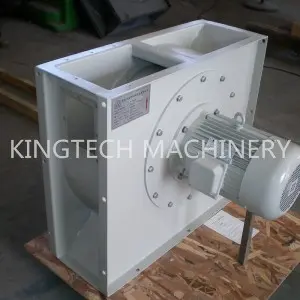
Kingtech’s FT Series includes different blower models for applications such as air-pressed feeding boxes, openers, cotton conveying, and dust removal. The product range provides different combinations of airflow, pressure, and motor power so the blower can be matched to different textile-machine systems.
This is more practical than assuming one blower specification is suitable for every conveying distance or pipeline layout.
How Can Fiber Conveying Problems Be Diagnosed?
A practical diagnosis should start with the pattern of the problem.If blockage always occurs at one elbow, inspect local pipe design and fiber accumulation. If output becomes irregular after material changes, compare bulk density and fiber condition. If performance gradually declines over several days or weeks, check filters, dust collectors, and other sources of increasing resistance.
Useful observations include:
- where fiber first begins to accumulate;
- whether the problem changes with production rate;
- whether upstream feeding is continuous;
- whether material moisture or bulk density has changed;
- whether dust collection resistance has increased;
- whether airflow at the discharge point has weakened.
Looking at the entire conveying path usually provides a clearer answer than evaluating the blower alone.
Kingtech FT Series Cotton Conveying Blower
Kingtech Machinery provides the FT Series Cotton Conveying Blower for applications including fiber opening, blowroom processes, carding, cotton suction and delivery, and dust removal in textile and nonwoven machinery systems. The series includes models intended for openers, cotton conveying, dust removal, and air-pressed feeding applications.
Different models provide different airflow and pressure characteristics, allowing the blower to be matched with the actual pipeline, production equipment, conveying distance, and material-handling requirement rather than relying on a single standard configuration.
For recycling lines that combine opening, cleaning, carding, feeding, or fiber collection, the conveying system can be considered together with the main processing equipment so that material moves continuously between stages.
Match the Blower to the Fiber and Pipeline
When planning a cotton or textile fiber conveying system, useful information includes the material type, fiber condition, production rate, conveying distance, pipe diameter, number of bends, connected equipment, and whether dust removal is included.
Providing these details makes it easier to determine whether a conveying problem requires more airflow, more pressure, a different pipeline arrangement, or an adjustment elsewhere in the process.
Contact Kingtech Machinery with your fiber type, conveying distance, pipeline layout, and production requirements to discuss a suitable FT Series Cotton Conveying Blower configuration.
Conclusion
A Cotton Conveying Blower is only one part of a pneumatic fiber transport system. Blockage can result from insufficient airflow, excessive resistance, poor pipe layout, unstable feeding, material changes, moisture, or dust accumulation.
The most effective solution is therefore not always a larger blower. Stable fiber transport depends on matching airflow and pressure with the pipeline, the fiber condition, and the equipment connected to the system.
When the entire conveying path is considered as one system, problems such as repeated blockage, uneven fiber discharge, and unstable material transfer become easier to diagnose and correct.
FAQ
1. Why does cotton fiber block inside a pneumatic conveying pipe?
Common causes include low air velocity, pipe resistance, sharp bends, unstable feeding, high fiber bulk density, moisture, and dust accumulation.
2. Will a larger Cotton Conveying Blower always solve fiber blockage?
No. If the blockage is caused by pipe layout, excessive resistance, unstable feeding, or local accumulation, increasing blower size alone may not solve the problem.
3. Why does fiber sometimes come out of the pipe in batches?
Uneven upstream feeding or temporary fiber accumulation inside the pipeline can cause material to move forward in bursts rather than continuously.
4. What information is useful when selecting a Cotton Conveying Blower?
Material type, production rate, conveying distance, pipe diameter, number of bends, required airflow and pressure, connected equipment, and dust-removal requirements are all useful for system matching.
Post time: Sep-22-2026