




An Edge Trim Opener Supplier should provide more than a machine that simply breaks nonwoven side waste into smaller pieces. In continuous nonwoven production, edge trim is generated at a predictable point but may differ greatly in bonding structure, thickness, fiber composition, trim width, and production speed. These differences determine how easily the material can be reopened and whether the recovered fiber is suitable for reuse.
A suitable Edge Trim Opener therefore needs to match both the waste material and the production environment. For factories planning to recover needle-punched, spunlace, thermal-bonded, air-through, spunbond, or other nonwoven edge waste, supplier capability is reflected in how well the machine configuration connects fiber recovery with actual production conditions.
Different Nonwoven Structures Need Different Opening Conditions
“Nonwoven edge trim” is a broad material category rather than one uniform type of waste.
Needle-punched materials rely on mechanical entanglement, while spunlace fabrics contain fibers entangled through high-pressure water. Thermal-bonded materials have heat-bonded areas, and air-through nonwovens may have a much loftier structure. These differences affect the force required to reopen the waste.
If the mechanical action is too weak, the recovered material may still contain compact strips or bonded fiber clusters. If it is unnecessarily strong, useful fiber can be shortened and more fines may be generated.
This is one reason an experienced Edge Trim Opener Supplier should first understand how the original nonwoven was produced rather than recommend equipment based only on trim width or production volume.
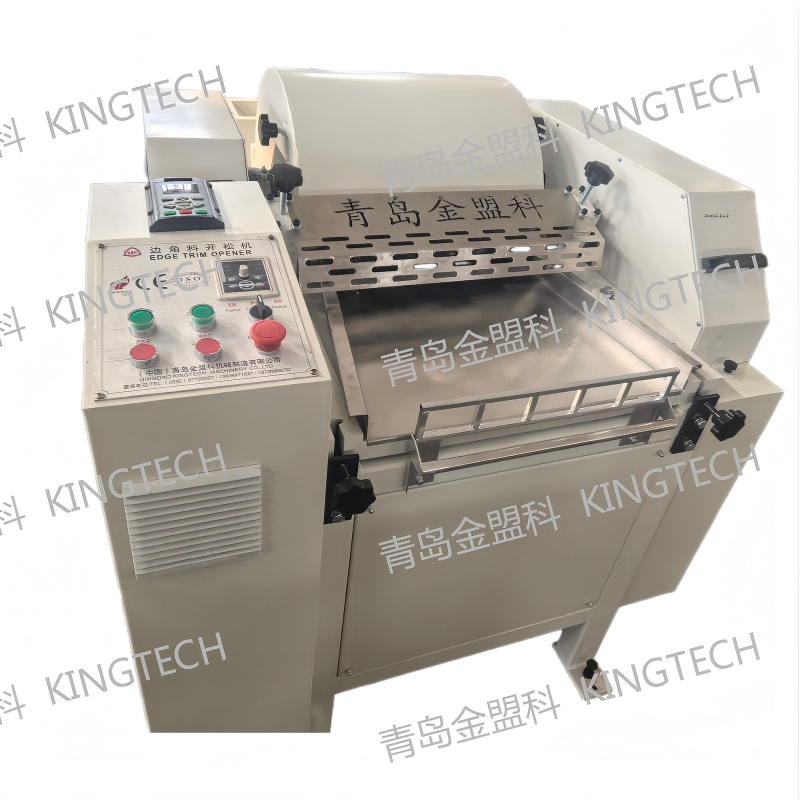
Kingtech Edge Trim Openers are designed for several nonwoven structures, including needle-punched, hot air-through, spunlace, thermal-bonded, hydro-entangled, and spunbond materials.
In-Line and Off-Line Recycling Require Different System Thinking
How edge trim is collected is just as important as what the material is made from.
In an in-line recycling system, edge trim is generated continuously while the nonwoven line is running. The opener needs to receive this waste without interfering with the normal production rhythm. If the trim accumulates faster than the recycling system can process it, the waste-handling stage itself can become a production problem.
Off-line recycling is different. Waste may first be collected as rolls, strips, or pieces and then processed separately. In this case, feeding, storage, fiber collection, and batch handling become more important than synchronization with the main nonwoven line.
Kingtech Edge Trim Openers can be configured for both in-line and off-line use. This gives factories more flexibility to choose a recycling route according to how edge waste is generated and managed.
Working Width Should Match the Actual Material Flow
Working width is one of the first specifications considered when selecting an Edge Trim Opener, but simply choosing the largest machine does not necessarily create a better system.
The correct width depends on several practical factors: the width of the trim, whether multiple trim streams will be processed together, how material is fed, and whether future production changes are expected.
Kingtech provides Edge Trim Opener working widths including 300 mm, 500 mm, 1000 mm, 1500 mm, and 2000 mm. Different widths allow the equipment to serve both smaller edge-waste streams and larger recycling applications.
The purpose of selecting a suitable working width is to maintain efficient material handling without unnecessarily oversizing the system.
A Good Edge Trim Opener Should Recover Usable Fiber, Not Just Reduce Waste Volume
One of the most important differences between ordinary waste size reduction and edge trim opening is the expected output.
The goal is not simply to make the waste disappear. An Edge Trim Opener should return the trim toward a loose fiber condition while preserving as much useful fiber as practical.
Several observations can help evaluate the result:
- whether continuous trim has been sufficiently separated;
- whether dense bonded pieces remain;
- whether fiber length is reasonably preserved;
- whether short fibers and dust increase excessively;
- whether the recovered material can be handled consistently in the next process.
This becomes especially important when recycled fiber is intended to return to nonwoven production.A machine that processes a large volume of trim but produces heavily damaged fiber may not provide the expected recycling value. For this reason, output fiber condition should be considered together with capacity.
Fiber Collection and Dust Control Should Be Considered Early
Opening converts compact strips into a much bulkier fiber mass. That change creates another engineering question: where does the recovered fiber go after leaving the opener?
Loose fiber requires suitable collection and transport. Mechanical opening can also release dust and fines, particularly when the waste has already experienced bonding, trimming, storage, or repeated handling.
For some production environments, a standalone opener may be enough. In others, a condenser, blower, dust collection unit, or pneumatic transport arrangement can make the system easier to operate.
Kingtech offers configurations combining opening with fiber collection and dust-removal equipment. This allows the recycling section to be designed as part of the production flow rather than treating the opener outlet as the end of the process.
Material Testing Is Useful for Unfamiliar Edge Trim
Machine specifications provide useful information, but they cannot fully predict how every nonwoven edge waste will behave.
Two materials with the same nominal fiber composition may differ because of bonding temperature, fiber fineness, fabric density, basis weight, production speed, or finishing process. Strongly bonded or unusually thick edge trim may behave very differently from standard production waste.
A material trial can help answer several practical questions before equipment configuration:
- Does the trim open easily or remain in compact clusters?
- Is one opening stage sufficient?
- How much fiber damage occurs?
- Does the recovered fiber meet the intended reuse requirement?
- Is additional collection or dust control necessary?
For edge waste that has not been processed before, these observations can provide more useful information than relying only on a standard capacity figure.
What Should an Edge Trim Opener Supplier Confirm Before Configuration?
A useful project discussion should include enough information to understand both the material and the production line.
| Information | Why It Matters |
|---|---|
| Nonwoven production method | Indicates bonding and opening difficulty |
| Fiber composition | Influences recycling behavior and reuse potential |
| Trim width and thickness | Helps determine equipment size and feeding |
| Continuous strip, roll, or pieces | Changes the feeding arrangement |
| Waste volume | Helps determine suitable processing capacity |
| Production speed | Important for in-line operation |
| Intended fiber reuse | Defines the required output condition |
These details help prevent a common problem: selecting a machine that can physically process the waste but does not fit the real production process.
Kingtech Edge Trim Opener Supplier Capabilities
Kingtech Machinery provides Edge Trim Opener solutions for nonwoven production waste, with models covering different working widths and material structures.
The equipment can be used with needle-punched, spunlace, hot air-through, thermal-bonded, hydro-entangled, spunbond, and other nonwoven waste. Depending on the project, systems can be configured for continuous in-line recovery or separate off-line processing.
Kingtech’s experience in textile recycling also extends beyond a single Edge Trim Opener. For projects where the recovered fiber requires additional processing, equipment such as Combined Opener Systems, Opening-Carding Systems, blowers, conveying equipment, cutters, and dust-control components can be integrated according to the application.
This is particularly useful when edge trim recycling develops from a simple side-waste recovery task into a more complete fiber-reuse system.
Match the Edge Trim Opener to Your Production Line
Before determining an Edge Trim Opener configuration, it is useful to provide information about the actual waste rather than only requesting a machine size.
Details such as nonwoven type, fiber composition, edge trim width, production speed, daily waste volume, and intended use of the recovered fiber can help establish a more realistic equipment configuration. Photos, videos, or representative samples are also useful for materials with unusual bonding or thickness.
Contact Kingtech Machinery with your nonwoven edge trim information to discuss a suitable Edge Trim Opener, working width, operating method, and supporting recycling equipment for your production line.
Conclusion
A reliable Edge Trim Opener Supplier needs to understand the connection between nonwoven structure, edge-waste generation, opening requirements, fiber recovery, and production-line integration.
The best configuration is not simply the widest or highest-capacity machine. It is the system that can process the specific edge trim continuously, recover fiber in a useful condition, and connect efficiently with the way the factory already handles production waste.
For this reason, material structure, operating mode, working width, recovered-fiber target, and supporting collection equipment should all be considered before an Edge Trim Opener is configured.
FAQ
1. What materials can an Edge Trim Opener process?
Edge Trim Openers can be used for several types of nonwoven production waste, including needle-punched, spunlace, air-through, thermal-bonded, hydro-entangled, and spunbond materials.
2. Can an Edge Trim Opener be installed directly on a nonwoven production line?
Yes. In-line configurations can continuously handle edge waste generated during production, while off-line systems can process separately collected trim.
3. What Edge Trim Opener working widths does Kingtech offer?
Kingtech provides working-width options including 300 mm, 500 mm, 1000 mm, 1500 mm, and 2000 mm.
4. What information is useful before selecting an Edge Trim Opener?
Nonwoven type, fiber composition, trim width, material form, waste volume, production speed, and the intended use of recovered fiber are all useful for determining an appropriate configuration.
Post time: Sep-18-2026