




Developing a new nonwoven material involves more than choosing compatible fibers. Blend ratio, fiber dimensions, web uniformity, and needle-punching conditions all influence the finished fabric. A promising formula may still produce an uneven web or inconsistent properties when processed. A Kingtech Laboratory Type Needle Punching Line helps turn fiber experiments into actual needle-punched samples under controlled conditions. By comparing trial results systematically, developers can identify processing limitations, refine material combinations, and establish a more informed starting point before moving to larger-scale production.
Start with the Intended Fabric Performance
A useful blend trial begins with the job the finished nonwoven must perform. The target application determines which properties matter and prevents testing from becoming a general exercise in producing samples.
For filtration media, relevant considerations may include permeability, particle retention, thickness consistency, and resistance to deformation. Geotextile development may place greater emphasis on tensile behavior, puncture resistance, and dimensional stability. Automotive, furniture, flooring, and roofing materials may require a different balance of strength, flexibility, bulk, surface quality, or durability.
Translate these requirements into measurable criteria before the first trial. Rather than recording only that a sample feels “firm,” define the thickness range or mechanical test used for comparison. This helps determine whether a change in fiber ratio delivers a measurable improvement.
Check Fiber Compatibility Before Processing
Fiber components can differ in length, fineness, crimp, surface characteristics, and moisture behavior. These differences influence how fibers separate, mix, transfer, and form a web. A blend may contain individually suitable fibers but still be difficult to process together.
Before a trial, record each component’s specifications and inspect the material for variation or contamination. Large differences in fiber length or fineness may contribute to uneven distribution or web formation.
The blend ratio should also be recorded by weight, with each trial prepared using the same weighing and mixing procedure. If the material is not mixed consistently before feeding, differences between samples may come from preparation rather than from the machine settings being evaluated.
This check does not replace machine testing, but gives each trial a more reliable starting point.
Evaluate the Blend Through Each Processing Stage
A laboratory needle-punching line connects several stages of fiber preparation and web consolidation. Observing the material at each stage helps identify where a problem begins, rather than treating every defect in the finished fabric as a needle-punching issue.
Opening and feeding
At the opening and feeding stages, observe whether the blend separates and enters the line consistently. Some fibers may open readily, while others may remain in small clusters or behave differently during feeding. Fluctuating material supply can also create variations in web weight before the web reaches the carding section.
If the blend feeds unevenly, first investigate material preparation, fiber characteristics, and feeding conditions. Increasing needle-punching intensity will not correct an inconsistent supply of fibers.
Carding and web formation
Carding distributes fibers to form a web. During a blend trial, inspect whether the web is even across its width and along its length. Look for visible fiber concentration, thin areas, holes, clumps, or unstable edges.
Cross-lapping can build the web to a required thickness or weight and arrange layers in a different direction. However, it should not be expected to correct poor fiber mixing or inconsistent carding. If the web entering the cross-lapper is already uneven, the original variation may remain in the layered structure.
Record web weight and thickness at consistent positions to see whether a blend or preparation change improves distribution.
Pre-punching and needle punching
Pre-punching and subsequent needle-punching stages consolidate the web through mechanical fiber entanglement. The response of each blend depends on its fiber characteristics, web structure, and processing conditions.
A weak or unstable sample may indicate insufficient consolidation, but simply increasing punching intensity is not always the best solution. More intensive needling can change fabric density, thickness, and fiber integrity. Make adjustments progressively and compare the results against the intended application requirements.
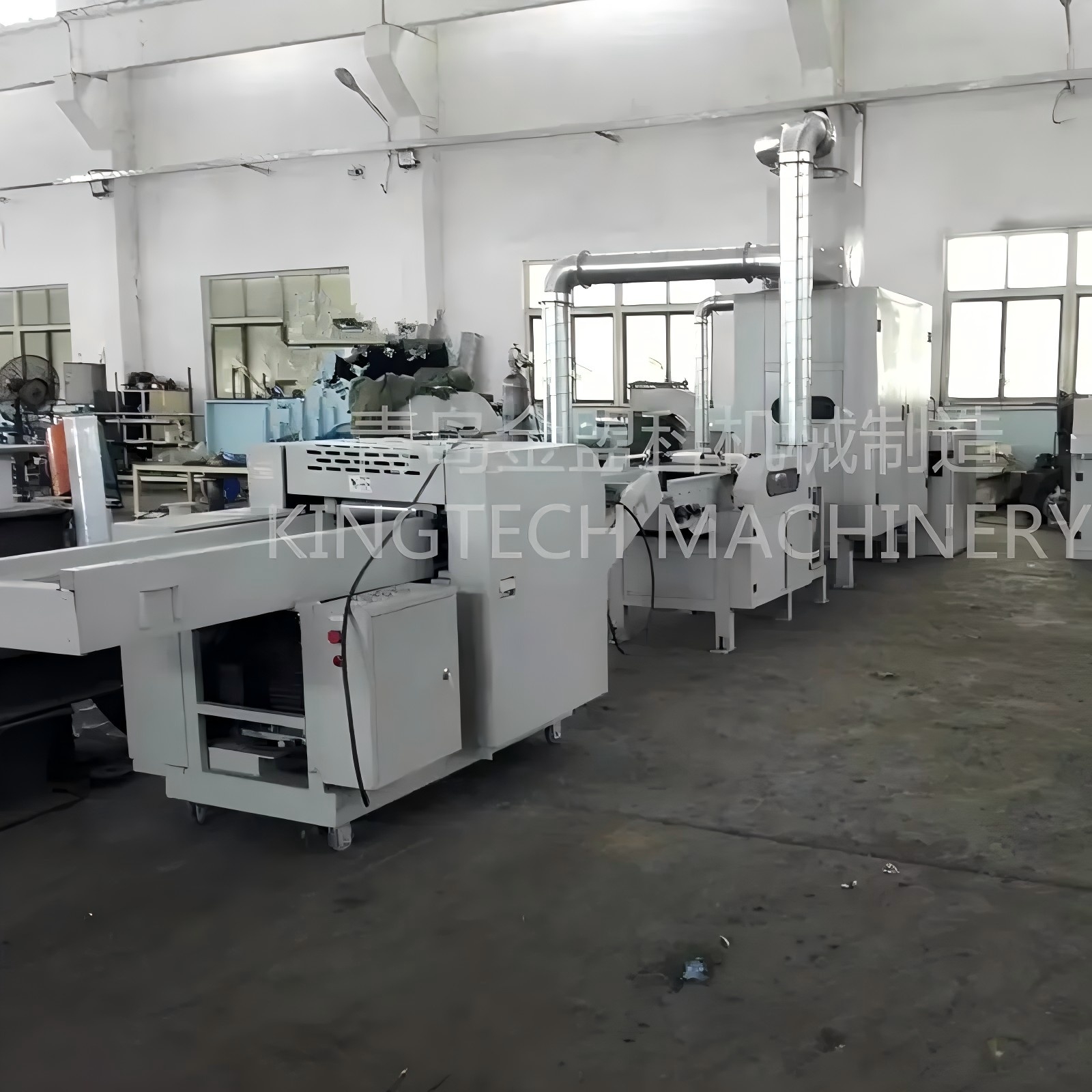
A Kingtech Laboratory Type Needle Punching Line also makes it easier to compare how different fiber combinations respond to the same processing sequence. By producing samples under consistent conditions, developers can examine whether changes in fiber composition affect web uniformity, fabric density, thickness, and bonding performance. This provides a practical basis for deciding whether a blend needs further adjustment or is ready for more detailed application testing.
Compare Samples with Consistent Evaluation Criteria
Visual inspection is useful for identifying obvious defects, but it cannot establish whether a sample meets its intended performance requirements. A fabric may look uniform and still fail a mechanical or functional test.
Use the same sampling method and test procedures for every blend. Depending on the application, the comparison may include:
| Evaluation area | What to check | What it can reveal |
|---|---|---|
| Fiber distribution | Visible uniformity and local concentration | Mixing or feeding inconsistencies |
| Web quality | Weight, thickness, holes, and edge stability | Whether the web is suitable for consolidation |
| Fabric structure | Density, thickness, and surface condition | How the blend responds to needling |
| Mechanical properties | Tensile, elongation, or puncture results as relevant | Whether the sample meets application needs |
| Repeatability | Variation between samples made under the same conditions | Whether the process is stable |
Select tests that directly affect the product’s function. Where possible, test multiple samples from each trial; one acceptable specimen cannot establish repeatability.
Change One Main Variable at a Time
Once the first samples are available, use controlled trials to understand what is driving the results. If the fiber ratio, web weight, feeding rate, and needle settings are all changed simultaneously, it becomes difficult to identify which adjustment caused an improvement or a defect.
A more reliable sequence is to compare a small number of blend ratios while keeping the main processing conditions consistent. After identifying a promising composition, investigate the effects of web weight or needle-punching conditions. Record every adjustment, sample identification, and test result.
Repeat the most promising trials to check whether the result can be reproduced. Differences may point to unstable feeding, inconsistent preparation, or a blend sensitive to small process changes.
The goal is to establish a practical process window: a range of material and operating conditions that consistently produces samples within the required specifications. This is more useful for production planning than relying on one successful machine setting.
Match the Laboratory Line to the Trial Requirements
The laboratory line configuration should reflect the fibers, target web, and experiments planned. Depending on the process, a setup may include opening, feeding, carding, cross-lapping, web feeding, pre-punching, and needle-punching stages. Cutting and winding equipment may be added when the sample collection process requires them.
Before selecting a line, confirm fiber type, length and fineness, target working width, sample structure, and testing procedure. Clarify whether additional needle-punching stages or sample-handling equipment are needed.
The Kingtech Laboratory Type Needle Punching Line is designed for laboratory-scale nonwoven sample development and experimental work. The published KTL1000NP configuration specifies fiber applications from 0.5 to 300 denier and fiber lengths up to 90 mm. Its listed process units include opening, carding, cross-lapping, pre-punching, and up-stroke and down-stroke needle-punching stages. These specifications are a reference for initial discussions; the configuration must be checked against the actual material and test objectives.
When discussing a project, provide the fiber types and blend ratios, fiber dimensions, target fabric width, intended application, and properties to be evaluated. This information helps determine which process stages are necessary and which configuration details need further confirmation.
Conclusion
A new fiber blend should be evaluated as a complete material-and-process combination. Its behavior during opening, feeding, carding, web formation, and needle punching can all affect the finished nonwoven. Consistent test criteria, controlled adjustments, and repeatable samples help identify the cause of problems and establish a practical starting point for further development.
A laboratory needle-punching line makes it possible to assess these factors through actual fabric samples rather than relying only on theoretical blend ratios. When the line configuration matches the material and testing objectives, the results can support better-informed decisions before production scale-up.
FAQ
1. Can a laboratory needle-punching line test different fiber blends?
Yes. It can be used to produce samples from different natural, synthetic, and regenerated fiber combinations, provided their specifications are compatible with the selected line configuration.
2. Why should a new fiber blend be tested before production?
Testing can reveal problems with mixing, feeding, web uniformity, and fabric consolidation before a larger production setup is committed to the material.
3. What information is needed to plan a fiber blend trial?
Useful information includes fiber types, blend ratios, fiber length and fineness, target fabric width, intended application, and the properties the finished sample must achieve.
4. Does every laboratory needle-punching line need cutting and winding equipment?
No. These units depend on sample handling and collection requirements. The necessary configuration should be determined by the trial procedure and the form in which samples need to be collected.
Post time: Nov-26-2026