




Non-woven fabric production generates different types of waste, including edge trims, rejected rolls, and leftover materials from converting processes. Recovering these materials can reduce production waste and provide reusable fibers for further applications. However, different non-woven fabrics do not respond to mechanical recycling in the same way. Spunlace and needle-punched fabrics have different structures and processing characteristics. A suitable Non Woven Fabric Recycling Machine must match these differences to achieve effective fiber recovery while avoiding unnecessary fiber damage.
For manufacturers considering recycling equipment, the important question is not simply whether a machine can process non-woven waste. It is whether the equipment can handle the actual material and produce fibers suitable for the intended application.
Understanding Spunlace and Needle-Punched Fabric Waste
Before choosing a Non Woven Fabric Recycling Machine, manufacturers should identify the type and condition of their waste. The original fabric manufacturing process affects how the material behaves during opening.
Spunlace Non-woven Waste
Spunlace fabric is produced by using high-pressure water jets to entangle fibers. The resulting material is generally soft and flexible, but its fibers remain interconnected.
During recycling, the equipment needs to loosen these fibers sufficiently for reuse. Insufficient opening may leave compacted bundles or fabric fragments in the output. Excessive mechanical action, however, can shorten fibers and reduce their potential for further processing.
For spunlace production waste, equipment selection should focus on controlled opening and stable feeding. Clean edge trims with consistent dimensions are generally easier to process than large rejected rolls or mixed materials.
Needle-Punched Non-woven Waste
Needle-punched fabric is manufactured by mechanically entangling fibers through repeated needle penetration. Depending on the product, the resulting material can be thick, dense, and strongly interconnected.
These characteristics may make some needle-punched waste more difficult to open than lightweight non-woven trims. Thick felt, automotive materials, and insulation fabrics may require preliminary cutting or multiple opening stages to achieve suitable fiber separation.
A Non Woven Fabric Recycling Machine for these applications should therefore be evaluated according to material thickness, feeding conditions, and the required output quality.
How to Choose the Right Recycling Equipment Configuration
When Is an Edge Trim Opener Suitable?
An edge trim opener is suitable for manufacturers that mainly generate continuous non-woven production trims.
For example, spunlace, needle-punched, and other non-woven production processes may generate narrow fabric edges that can be collected and returned for fiber recovery.
This equipment is worth considering when:
- Waste mainly consists of regular non-woven edge trims.
- Material composition and dimensions are relatively consistent.
- Foreign materials have been removed.
- The recovered fibers can be used in suitable downstream applications.
However, an edge trim opener should not automatically be considered suitable for all rejected rolls or thick non-woven scraps. Large and irregular materials may require additional preparation.
When Is a Combined Opener System Necessary?
A combined opener system may be more appropriate for thick, compact, or strongly entangled materials that cannot achieve the required opening result in one stage.
For some needle-punched fabrics, the first opening stage loosens the material but may not fully separate the fiber bundles. Additional opening stages can provide further processing and improve output consistency.
This configuration may be considered for thick felt waste, large non-woven scraps, and materials with relatively high opening requirements.
The number of processing stages should be determined through material testing. Adding more equipment does not automatically guarantee better fiber quality.
When Should an Opening and Carding System Be Considered?
Opening and carding perform different functions. Opening loosens compacted materials and separates fiber bundles, while carding further separates and arranges fibers into a more uniform condition.
If recovered fibers are intended for applications requiring better fiber distribution, an opening and carding system may be more suitable than an opener alone.
For example, manufacturers planning to reuse recovered fibers in non-woven production should consider whether the output requires additional fiber arrangement. For basic filling applications, additional carding may not always be necessary.
What Affects the Performance of a Non Woven Fabric Recycling Machine?
Selecting the right equipment type is only part of the process. Actual recycling performance also depends on several material conditions.
Material thickness and density: Thick needle-punched fabrics may require more preparation and stronger opening arrangements than lightweight spunlace edge trims.
Fiber composition: Natural fibers, synthetic fibers, and blended materials can respond differently to mechanical processing. Equipment suitability should be confirmed for the actual material rather than assumed from general product descriptions.
Waste cleanliness: Dust, oil, adhesives, plastic film, labels, and other foreign materials may affect processing stability and limit the reuse of recovered fibers. Sorting unsuitable components before recycling helps reduce these problems.
Feeding consistency: Irregular feeding can cause uneven machine loading, material accumulation, and fluctuations in output quality. The feeding arrangement should match the size, shape, and expected volume of the waste.
These factors should be considered together when evaluating a Non-Woven Fabric Recycling Machine, especially when the factory processes multiple types of non-woven materials.
How to Evaluate Recovered Fiber Before Purchasing Equipment
A machine’s nominal processing capacity does not fully indicate whether it is suitable for a particular recycling application. Manufacturers should also evaluate the quality and usability of the recovered fibers.
Before purchasing a Non-Woven Fabric Recycling Machine, prepare representative samples of the actual production waste. Include different material types if the equipment will process more than one waste stream.
The following points are useful during testing:
| Evaluation factor | What to check |
|---|---|
| Opening condition | Whether unopened fabric pieces or compacted fiber bundles remain |
| Fiber length | Whether excessive fiber shortening occurs |
| Output consistency | Whether recovered fibers have a reasonably uniform condition |
| Processing stability | Whether materials can be fed and processed continuously |
| Application suitability | Whether the recovered fibers meet downstream requirements |
The most suitable recycling result is not necessarily the finest or most completely separated fiber. It is the output that can be reliably used in the intended application.
Manufacturers should also test whether the machine can handle changes in material thickness, composition, and waste dimensions. A solution that works well with clean edge trims may require a different configuration for thick needle-punched fabrics.
Building a Suitable Non-woven Recycling Line
A recycling line should be designed around the actual waste stream rather than assembled by simply adding more machines.
Large or irregular scraps may require cutting before opening to improve feeding. Thick needle-punched materials may benefit from progressive opening, while recovered fibers intended for more uniform downstream processing may require carding.
Dust removal and material collection should also be considered when designing the production arrangement. These supporting systems help manage material flow and the processing environment.
The goal is to balance processing requirements with equipment investment. An undersized configuration may limit production performance, while unnecessary equipment can increase operating complexity.
Non Woven Fabric Recycling Solutions from Kingtech Machinery
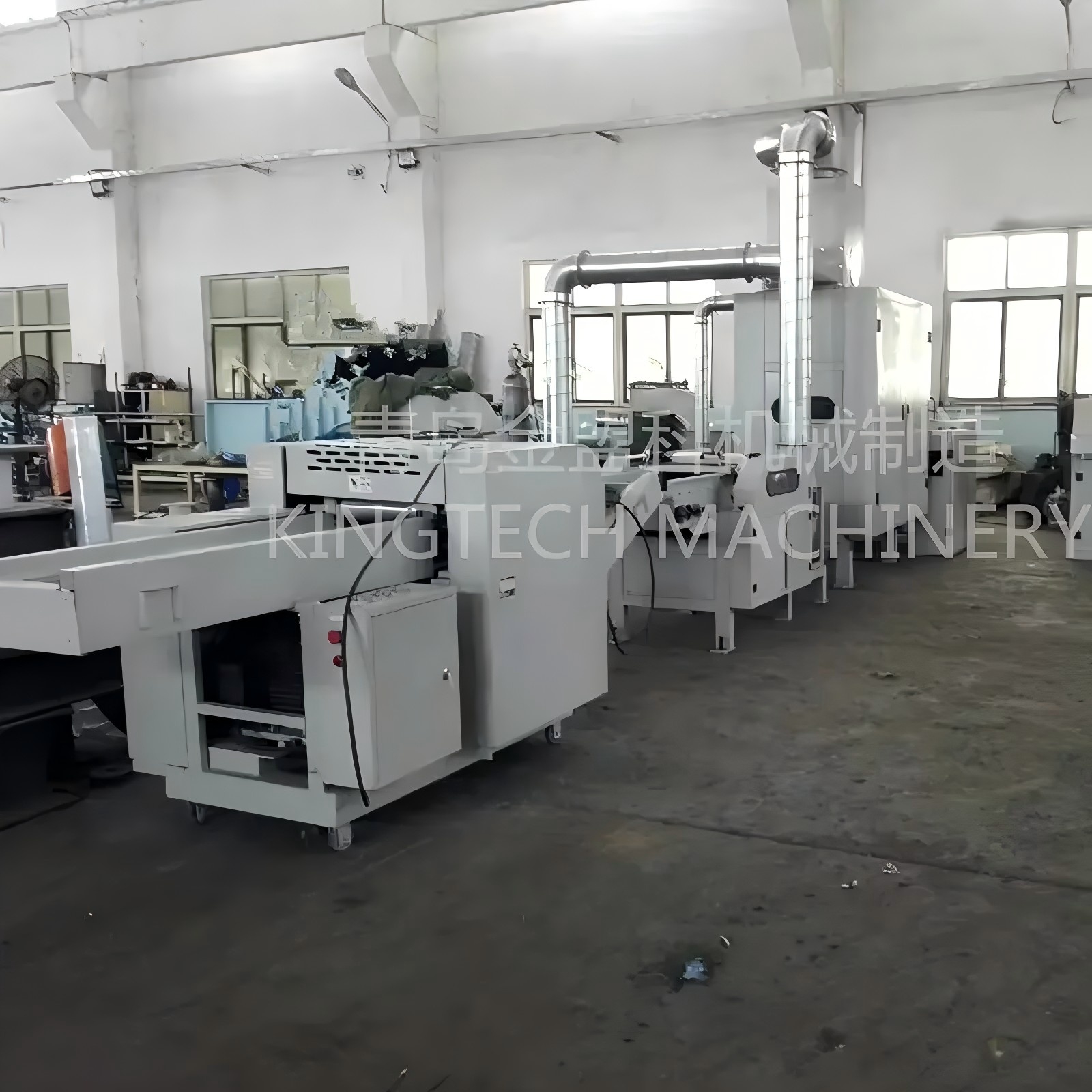
Kingtech Machinery provides equipment for non-woven and textile waste recycling applications, including edge trim openers, combined opening systems, and opening-carding systems.
For manufacturers processing regular production trims, an edge trim opener may provide a practical solution. For thicker or more difficult materials, combined opening equipment can provide additional processing stages. When recovered fibers require further separation and improved uniformity, an opening and carding arrangement can be considered.
The appropriate Non-Woven Fabric Recycling Machine depends on the material type, physical condition, expected processing volume, and intended use of recovered fibers. Evaluating these factors together helps manufacturers identify a suitable equipment configuration.
Conclusion
Choosing a Non Woven Fabric Recycling Machine for spunlace and needle-punched waste requires understanding the original fabric structure and the required recycling result.
Spunlace waste may need controlled fiber separation, while thick needle-punched materials may require preliminary cutting or multiple opening stages. Edge trim openers, combined opener systems, and opening-carding lines serve different processing needs.
Before purchasing equipment, manufacturers should test representative waste samples, evaluate recovered fiber quality, and consider how the machine will fit into existing production operations. A properly matched solution can help recover usable fibers and reduce non-woven production waste.
FAQ
1. Can a Non Woven Fabric Recycling Machine process both spunlace and needle-punched waste?
Some equipment configurations can handle both materials, but suitability depends on fabric thickness, fiber composition, and required output. Testing both materials before selecting equipment is recommended.
2. Does needle-punched fabric always require multiple opening stages?
No. Lightweight materials may be processed with a single opener, while thick or compact fabrics may benefit from combined opening equipment. The actual configuration depends on material testing.
3. Can an edge trim opener process rejected non-woven rolls?
An edge trim opener is mainly designed for production edge waste. Large rejected rolls may require cutting or a different feeding arrangement. Material dimensions and condition should be checked before selecting equipment.
4. What is the difference between an opener and an opening-carding system?
An opener loosens compacted material and separates fiber bundles. An opening-carding system adds a carding stage to further separate and arrange fibers, which is useful when downstream applications require better fiber uniformity.
Post time: Nov-17-2026