




A Polyester Fiber Carding Machine is mainly used to further card and even out polyester fibers that have already gone through the initial opening process. When recycled polyester fiber is already relatively loose but still contains small fiber clusters, local density variations, or unstable downstream feeding, simply increasing the opening intensity often does not solve the real problem. This is where a Polyester Fiber Carding Machine becomes important in a polyester fiber recycling system.
In actual production, opening and carding solve problems at two different stages. Opening mainly breaks down the original structure of waste yarn, fabric, or nonwoven material and gradually converts it into a fibrous form. A Polyester Fiber Carding Machine, however, focuses more on whether the opened fibers are sufficiently separated, evenly distributed, and stable enough to enter downstream processes such as nonwoven production, needle punching, or web forming. Therefore, whether polyester fiber needs further carding should not be judged only by how fluffy the material looks, but by fiber uniformity and downstream processing performance.
What Is the Difference Between a Polyester Fiber Carding Machine and Opening Equipment?
Opening and carding are closely related, but they cannot replace each other.
The main purpose of opening is to break down the original textile structure. Polyester yarn waste may need to be gradually loosened from twisted yarn bundles, while fabric waste needs to be separated from woven, knitted, or bonded structures and brought back toward a fibrous state. The opening stage therefore mainly deals with compression, entanglement, and the original structural connections between fibers.
Carding usually takes place after the material has already been substantially loosened. A Polyester Fiber Carding Machine further separates remaining small fiber clusters, improves fiber distribution throughout the material stream, and reduces local density differences.
| Process | Main Function | Main Problem Solved |
|---|---|---|
| Opening | Breaks down compact or complete textile structures | Fabric pieces, yarn bundles, dense fiber masses |
| Polyester Fiber Carding Machine | Further organizes and evenly distributes fibers | Small fiber clusters, local density differences, insufficient overall uniformity |
If the material still contains obvious fabric pieces, tight yarn bundles, or large compact fiber clusters, the opening process is usually still insufficient and may need to be strengthened or extended. However, if the material is already loose but the fibers remain unevenly distributed, additional opening may only increase fiber damage. In that case, carding is usually more suitable than stronger opening.
Why Can Loose Polyester Fiber Still Be Uneven?
A common misunderstanding in fiber recycling is that once the material looks fluffy, it must already be fully processed.In reality, loose polyester fiber can still contain considerable internal variation. Some areas may be well separated, while others still contain compact small fiber bundles. Bulk density can also vary noticeably from one part of the fiber stream to another.
This unevenness can come from several sources. Polyester fabrics do not break down at exactly the same rate across every area during opening. Yarn waste may contain different twist levels. Nonwoven materials may have different levels of thermal bonding or mechanical entanglement in different areas. Uneven feeding during the opening stage can also cause different portions of the material to receive different amounts of mechanical action.As a result, two batches of opened polyester fiber may look similar from a distance but behave very differently when they enter the next machine.
A Polyester Fiber Carding Machine can further organize these fibers, helping achieve more stable separation and a more even fiber distribution across the working width.
Fiber Uniformity Matters More Than a Fluffy Appearance
For many downstream applications, even fiber distribution is more important than how fluffy the recycled material looks.
If fiber distribution is unstable, downstream equipment may receive alternating dense and light sections. This can affect web weight, feeding stability, product thickness, and overall process consistency.
For example, in nonwoven production, uneven fiber feeding can create local differences in web density. After needle punching, these differences may become more visible as inconsistent thickness or mechanical properties in the finished material. In air-lay forming or other web-forming processes, fluctuations in fiber distribution can also make it more difficult to maintain stable production conditions.
For this reason, the performance of a Polyester Fiber Carding Machine should not be judged only by how fluffy the fiber looks. The condition of the entire fiber stream is more important.
Useful indicators include:
- whether obvious large or small fiber clusters remain;
- whether output density varies noticeably across different areas;
- whether fiber feeding remains stable over time;
- whether downstream web formation becomes more uniform;
- whether short-fiber and dust generation remain under control.
A good carding result should improve fiber uniformity without creating unnecessary fiber damage.
More Opening Cannot Always Replace a Polyester Fiber Carding Machine
When opened polyester fiber is still uneven, it may seem logical to simply add more opening stages. However, this is not always the most effective solution.
Opening equipment uses mechanical action to break down compact structures. Once the original fabric or yarn structure has already been largely removed, further opening may bring less and less improvement. The fibers may become slightly looser, but short-fiber generation, dust, and fiber breakage may also increase.
Carding addresses a different issue. It works with material that is already mainly in fiber form and focuses on improving separation, distribution, and uniformity rather than repeatedly breaking down the original structure.
A practical process rule is:If the main problem is still a compact textile structure, improve the opening stage. If the material is already loose but uneven, a Polyester Fiber Carding Machine is usually more valuable than stronger opening. This distinction can reduce unnecessary mechanical treatment and help preserve more usable fiber length.
Different Polyester Waste Requires Different Carding Expectations
Not all polyester waste should be evaluated according to the same carding standard.Polyester yarn waste may retain relatively long fibers but still contain residual yarn bundles after opening. In this case, carding can improve fiber separation while helping preserve useful fiber length.
Polyester fabric waste is more complex. The original fibers have already gone through spinning, weaving or knitting, finishing, and then mechanical recycling. As a result, the recovered fibers may show a wider range of fiber lengths.
Polyester nonwoven waste can vary even more. Needle-punched materials, spunlace waste, thermal-bonded nonwovens, and other structures use different bonding methods. Some materials open relatively easily, while others may still retain small bonded fiber clusters after the first opening stages.
Therefore, the purpose of a Polyester Fiber Carding Machine is not to make every type of polyester waste look identical. The more practical goal is to bring recycled fibers from different sources into a stable condition suitable for the next process.
How Can the Carding Performance of a Polyester Fiber Carding Machine Be Evaluated?
Carding quality is best evaluated by combining direct fiber observation with downstream production performance.
Several indicators are especially useful:
Residual Fiber Bundles
If many compact small fiber bundles remain after carding, fiber separation may still be insufficient. However, a small number of remaining clusters does not automatically mean the entire system needs stronger mechanical treatment.
Fiber Length Retention
If very short fibers increase noticeably after carding, the mechanical action may be too strong. Better fiber separation should not come at the cost of excessive fiber damage.
Output Uniformity
The fiber stream should remain relatively stable over time and across the machine working width. Large local density variations can later affect feeding and web formation.
Downstream Process Stability
One of the most useful indicators is how the material behaves in the next process. If feeding becomes smoother and web formation becomes more stable after carding, this is usually a strong sign that fiber condition has improved.
For this reason, carding quality should not be judged only at the carding machine outlet. The downstream process often gives a clearer indication of whether the fiber has reached a suitable condition.
When Is Carding Necessary After Polyester Opening?
Not every polyester recycling application requires a Polyester Fiber Carding Machine.
If the recycled fiber is mainly used for filling applications with relatively low uniformity requirements, and the opened material is already loose and stable enough, adding a carding stage may provide limited additional value.
However, carding becomes more useful when the downstream process requires better control of fiber distribution. This is especially relevant for applications such as:
- nonwoven production;
- needle punching;
- air-lay forming;
- other processes requiring better fiber uniformity and continuous feeding stability.
Therefore, whether carding is necessary should depend on the required fiber condition rather than on the assumption that “more machines mean better recycling.”
Kingtech Polyester Fiber Carding Machine and Opening-Carding Solutions
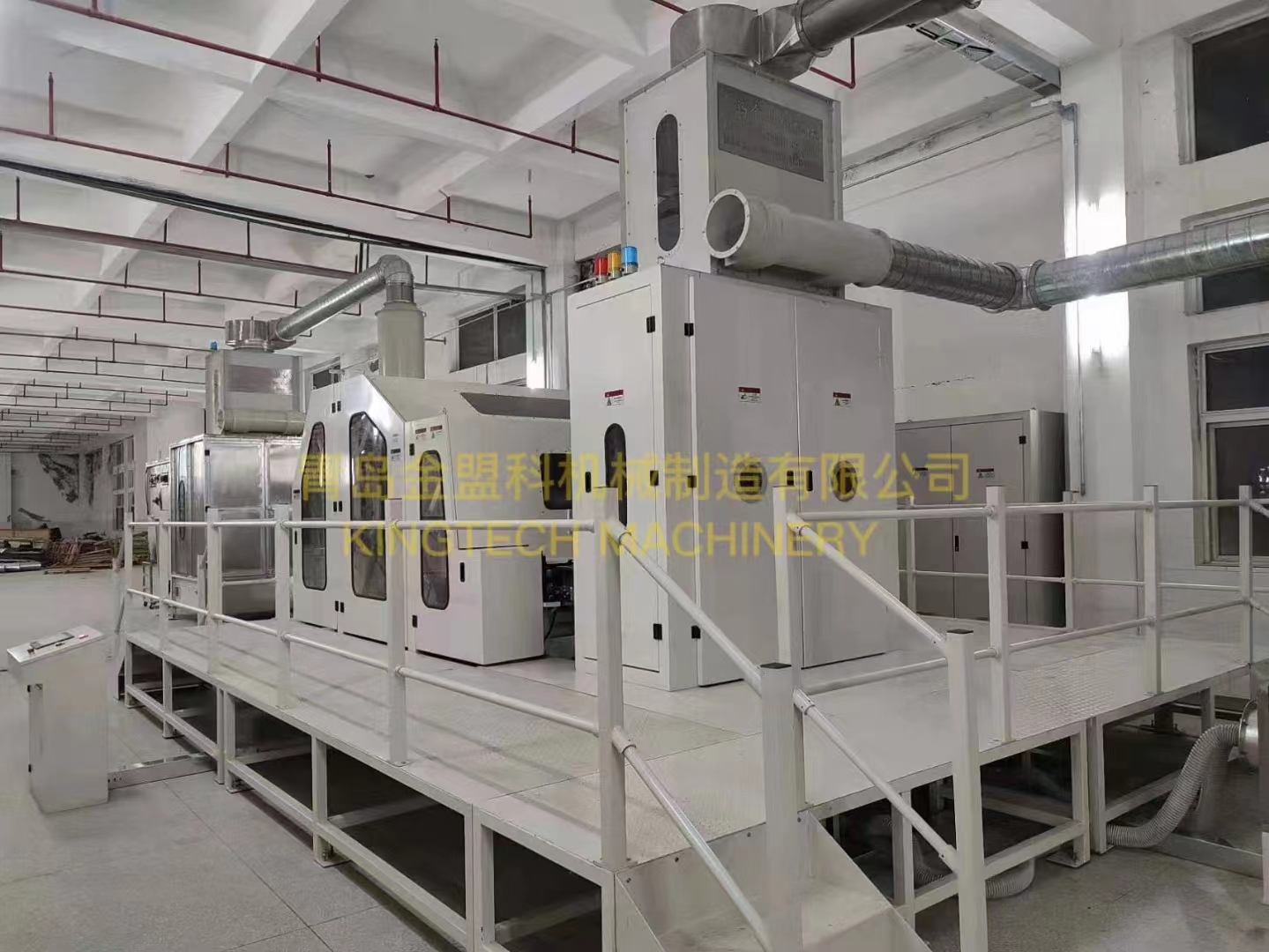
Kingtech Machinery provides Polyester Fiber Carding Machine solutions through its Opening-Carding System for polyester yarn waste, textile waste, nonwoven materials, and other recycling applications where better fiber separation and uniformity are required.
The system can combine one or more opening machines with one or more carding machines according to the actual raw material condition. Different production requirements can also be matched with different working widths, while the overall process can be adjusted depending on whether the waste comes from yarn, fabric, nonwoven materials, or other textile forms.
For more difficult textile waste, Kingtech can also combine opening and carding with front-end cutting, feeding, conveying, and other recycling equipment. The goal is not simply to add more processing stages, but to ensure that each stage has a clear function based on the actual material condition and the required recycled fiber output.
Conclusion
When polyester fiber has already become relatively loose after opening but still lacks sufficient overall uniformity, a Polyester Fiber Carding Machine can play an important role.
Opening and carding solve different problems. Opening breaks down the original textile structure and gradually returns the material to a fibrous state, while carding further improves the separation, distribution, and downstream processing stability of the opened fibers. Once the material is already loose enough, increasing opening intensity may no longer be the most effective solution.
For this reason, carding performance should not be judged only by fiber appearance. Fiber uniformity, residual bundles, fiber length retention, and downstream production stability provide more useful indications.
A properly matched opening and carding process can help recycled polyester fiber reach a more stable and controlled condition while reducing unnecessary mechanical damage.
FAQ
1. What is the main function of a Polyester Fiber Carding Machine?
It is mainly used to further separate and evenly distribute opened polyester fibers, improving fiber uniformity and downstream feeding stability.
2. Does polyester fiber always need a Polyester Fiber Carding Machine after opening?
No. If the opened fiber condition already meets the requirements of the final application, additional carding may not be necessary. Carding becomes more useful when the downstream process requires better fiber distribution and consistency.
3. Can more opening stages replace carding?
Not always. If the material is already loose but uneven, stronger opening may increase fiber damage without significantly improving uniformity. In this condition, carding is usually more suitable.
4. How can polyester fiber carding quality be evaluated?
Useful indicators include residual fiber bundles, fiber length retention, output density uniformity, short-fiber generation, and the stability of downstream feeding and web formation.
Post time: Sep-08-2026