




A Yarn Recycling Machine is used to turn yarn waste, roving waste, tangled fiber bundles, and similar textile materials back into loose reusable fiber. However, successful yarn recycling is not simply about opening the material as much as possible. The real goal is to separate the yarn while keeping the recovered fiber long, clean, uniform, and suitable for the next process.
Different yarn wastes behave differently during opening. Cotton yarn, polyester yarn, blended yarn, roving, and heavily tangled waste may all require different processing strength and equipment combinations. If opening is too weak, unopened bundles remain. If it is too aggressive, more short fibers and dust may be produced.
For this reason, the performance of a Yarn Recycling Machine should be evaluated by fiber condition, not only by how fluffy the material looks after processing.
How Does a Yarn Recycling Machine Handle Different Yarn Waste?
A Yarn Recycling Machine may receive materials that look similar but behave very differently once they enter the opening process. Fiber type, yarn twist, tangling, bundle density, and contamination all influence the result.
| Yarn Waste Type | Main Processing Problem | Processing Focus | Typical Equipment Direction |
|---|---|---|---|
| Cotton yarn waste | Twist and compact bundles | Controlled opening with fiber protection | Opening or opening-carding |
| Polyester yarn waste | Strong fibers and easy tangling | Stable feeding and gradual opening | Controlled multi-stage opening |
| Blended yarn waste | Different fibers in one material | Consistent separation | Opening with possible carding |
| Roving waste | Loose but compact fiber bundles | Gentle loosening | Opening, carding if needed |
| Tangled yarn waste | Knots and irregular bundles | Feed preparation and gradual separation | Pre-opening or combined opening |
This does not mean every batch needs a different machine. It means the recycling process should be adjusted according to the actual condition of the yarn waste.
Opening Efficiency and Fiber Preservation Need to Stay Balanced
One of the most important principles in yarn recycling is that stronger opening is not always better.
If mechanical action is too weak, yarn pieces and compact fiber bundles remain unopened. These materials may cause uneven feeding later.
If mechanical action is too strong, fibers can be repeatedly pulled, torn, and shortened. This can increase short-fiber content and dust while reducing the usefulness of the recovered material.
The ideal result is somewhere in between:
- Enough opening to separate yarn bundles
- Minimum unnecessary fiber breakage
- Few remaining knots or compact pieces
- Stable and uniform loose fiber
- Good feeding performance in the next process
This balance is especially important when the recycled fiber will be used in nonwoven, needle-punched, filling, or other continuous production processes.
Six Practical Indicators for Evaluating Recycled Yarn Fiber
Instead of judging recycled fiber only by appearance, six simple indicators can provide a clearer picture of processing quality.
| Indicator | What It Shows | Possible Warning Sign |
| Fiber length | How well fibers are preserved | Too many shortened fibers |
| Unopened bundles | Whether opening is sufficient | Yarn pieces or compact clumps remain |
| Short-fiber content | Level of mechanical damage | Large amount of fine short fiber |
| Dust level | Fiber breakage or contamination | Excessive dust after opening |
| Fiber uniformity | Consistency of the output | Mixture of loose fiber and hard clumps |
| Feeding stability | Suitability for the next process | Irregular feeding or frequent blockage |
These six indicators are useful because they connect machine performance directly with the condition of the recovered fiber.
A material that looks very fluffy may still contain too many short fibers. Another batch may retain good fiber length but still have many unopened bundles. Both results indicate that the process needs adjustment.
Why Yarn Twist Changes Recycling Difficulty
Yarn twist helps hold fibers together during textile production, but it also makes waste yarn more difficult to separate during recycling.
Loosely structured yarn or roving can usually be opened with less mechanical action. Tightly twisted or heavily tangled yarn requires more work to separate the fibers.
This creates two common situations:
Low opening intensity:
The yarn may remain in strips, knots, or fiber bundles.
Excessive opening intensity:
The material opens completely, but more fibers may become shortened or damaged.
Therefore, the right opening setting depends on how strongly the fibers are held together before recycling. The machine should gradually loosen the structure instead of relying only on strong tearing.
When Is Opening Enough?
Not every yarn recycling process needs carding.
For some applications, the main requirement is simply to turn yarn waste into loose fiber. This may be enough for ordinary filling, padding, or applications where very high fiber uniformity is not required.
Opening alone may be suitable when:
- Yarn waste is relatively loose
- Few fiber bundles remain after opening
- Recovered fiber is used for filling
- Downstream feeding does not require highly uniform fiber
In these cases, adding more processing stages may provide little practical benefit.
When Is Opening-Carding More Suitable?
Carding becomes more useful when the recovered fiber needs better separation and distribution.
After opening, some fibers may still remain in small bundles or uneven clusters. Carding helps further separate these fibers and create a more consistent material condition.
Opening-carding is more suitable when recycled fiber will be used for:
- Nonwoven fabric
- Needle-punched felt
- Air-laid products
- More uniform filling
- Industrial textile layers
- Processes requiring stable fiber feeding
A simple rule is:
Opening makes the material loose. Carding makes the fiber more uniform.
The final application should determine whether carding is necessary.
Choosing the Right System for Yarn Waste
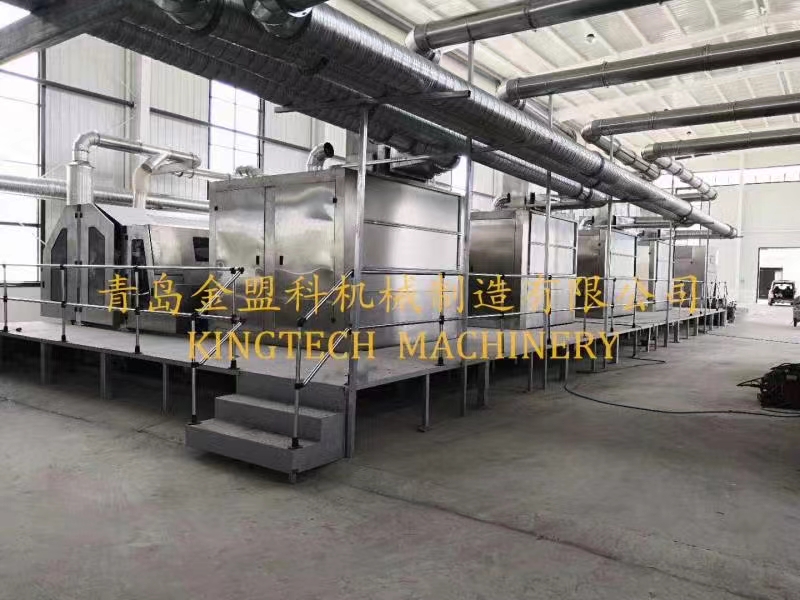
For yarn waste, cotton yarn waste, polyester yarn waste, roving, and similar fiber bundles, an Opening-Carding System is useful when both fiber separation and uniformity are important.
For more tangled or difficult textile waste, a Combined Opener System can provide gradual multi-stage opening before the material moves to later processing.
Kingtech Machinery provides both systems for different textile waste conditions. The suitable configuration depends on factors such as yarn type, degree of tangling, required capacity, fiber condition after opening, and final application.
The key is not to use the strongest or most complex configuration, but to select enough processing to achieve stable fiber recovery without unnecessary fiber damage.
Conclusion
A Yarn Recycling Machine should be evaluated by the quality of the recovered fiber, not simply by whether waste yarn has been fully opened.
Six practical indicators provide a useful way to judge the result: fiber length, unopened bundles, short-fiber content, dust level, fiber uniformity, and downstream feeding stability.
Different yarn wastes require different levels of opening. Simple materials may only need controlled opening, while tangled yarn or applications requiring more uniform fiber may benefit from multi-stage opening or opening-carding.
The best recycling result comes from finding the balance between sufficient fiber separation and fiber preservation.
FAQ
1. What materials can a Yarn Recycling Machine process?
It can process cotton yarn waste, polyester yarn waste, blended yarn waste, roving waste, tangled yarn, and similar fiber-based textile waste.
2. How can recycled yarn fiber quality be checked?
Useful indicators include fiber length, unopened bundles, short-fiber content, dust level, fiber uniformity, and feeding stability in the next process.
3. Does stronger opening always improve yarn recycling?
No. Stronger opening may reduce unopened material, but excessive mechanical action can also increase fiber breakage, short fibers, and dust.
4. When is an Opening-Carding System better than opening alone?
Opening-carding is more suitable when the recovered fiber needs better separation and uniformity for nonwoven, needle punching, air-laid, or other processes requiring stable fiber distribution.
Post time: Aug-13-2026