




A Non Woven Recycling Machine is used to process production waste, edge trims, rejected rolls, offcuts, and other nonwoven materials into reusable fiber. However, nonwoven waste cannot all be treated in the same way. Spunbond, spunlace, needle-punched, air-through, and thermal-bonded fabrics have different fiber structures, bonding methods, thicknesses, and densities, so their recycling difficulty can vary significantly.
For a Non Woven Recycling Machine, the key question is not simply whether the material can be opened. A suitable process should also consider how strongly the fibers are bonded, whether the waste is clean production scrap or mixed material, how much fiber damage occurs during opening, and what the recovered fiber will be used for afterward.
Understanding the original nonwoven structure is therefore one of the most useful starting points for choosing a recycling method.
How Does a Non Woven Recycling Machine Handle Different Nonwoven Structures?
Unlike woven and knitted fabrics, nonwovens are formed by bonding or entangling fibers directly. Different manufacturing methods create different internal structures, and those structures respond differently to mechanical recycling.
| Nonwoven Type | Typical Structure | Main Recycling Difficulty | Processing Focus |
|---|---|---|---|
| Spunbond | Continuous filaments bonded into a web | Strong, continuous structure | Controlled opening |
| Spunlace | Fibers entangled by high-pressure water | Dense fiber entanglement | Fiber separation with limited damage |
| Needle-punched | Fibers mechanically entangled by needles | Thick and compact structure | Gradual or multi-stage opening |
| Air-through | Lofty web bonded by hot air | Bulky but relatively loose | Stable feeding and gentle opening |
| Thermal-bonded | Fiber intersections fixed by heat | Bonded points resist separation | Progressive opening |
| Edge trim waste | Clean, narrow production waste | Continuous feeding rather than contamination | Direct edge-trim opening |
This comparison shows why “nonwoven waste” is too broad to describe one single recycling condition.
Spunbond Waste: Continuous Filaments Change the Process
Spunbond material is usually made from continuous filaments rather than short staple fibers. This gives the fabric strength, but it can also make the material more resistant to separation.
During recycling, long filament structures may wrap, stretch, or remain connected if the opening action is insufficient. On the other hand, excessive mechanical action may generate more fine material.
For spunbond waste, useful processing goals include:
- Stable feeding
- Controlled separation
- Avoiding excessive wrapping
- Reducing large unopened pieces
- Keeping the output suitable for its next application
Clean spunbond edge waste may be easier to process than complete rejected rolls because the material is narrower and more regular.
Spunlace Waste: Opening Without Unnecessary Fiber Damage
Spunlace nonwoven is formed by entangling fibers with high-pressure water jets. Although no traditional yarn structure is present, the fibers can still be closely intertwined.
This means the material may require enough opening force to separate the web, but excessive repeated processing can shorten the recovered fibers.
For spunlace waste, the aim is usually not to “shred it as finely as possible.” A better target is to obtain loose fiber while limiting unnecessary damage.
The processing result can be checked by looking at:
- Remaining fabric fragments
- Fiber length
- Large fiber bundles
- Fine fiber and dust
- Uniformity of the opened material
If the recovered fiber will enter nonwoven production again, fiber condition becomes more important than simply achieving maximum material reduction.
Needle-Punched Waste: Thickness Matters as Much as Fiber Type
Needle-punched nonwoven can be much thicker and denser than lightweight nonwoven materials. Repeated needle penetration mechanically locks fibers together, creating a structure that may be difficult to open in one stage.
Heavy needle-punched felt may therefore require:
- Size reduction before opening
- More than one opening stage
- Gradual fiber separation
- Stronger equipment structure
- Careful observation of fiber damage
A thick needle-punched material should not be treated in exactly the same way as light edge trim waste.
When large compact pieces remain after the first opening stage, a Combined Opener System can be more useful than simply increasing the force of one opener.
Air-Through and Thermal-Bonded Waste Need Different Attention
Air-through nonwoven is generally bulky and relatively loose. Its recycling challenge may be less about breaking a dense textile structure and more about maintaining continuous, even feeding.
Thermal-bonded material is different because heat creates bonding points between fibers. These bonded areas may resist separation even when the surrounding fibers have already become loose.
This creates a useful distinction:
Lofty material often needs feeding control.
Bonded material often needs controlled separation.
Looking at bonding method can therefore be more useful than judging recycling difficulty only by fabric thickness.
Why Edge Trim Waste Is a Separate Recycling Case
Edge trims generated during nonwoven production are often cleaner and more consistent than post-production textile waste. They may come directly from trimming or converting processes and usually have a known fiber composition.
Because the material is continuous and relatively clean, the recycling goal is often to return it to fiber form with as little unnecessary handling as possible.
An Edge Trim Opener is particularly suitable for this type of waste because it can process narrow nonwoven trims continuously instead of treating them like mixed textile scraps.
Typical edge-trim applications include:
- Spunlace edge waste
- Air-through nonwoven trims
- Needle-punched edge waste
- Thermal-bonded trims
- Other continuous nonwoven production scraps
For this type of material, a complex multi-stage recycling line may not always be necessary.
How to Decide Between Direct Opening and Multi-Stage Opening
A practical way to select the process is to look at material structure rather than machine quantity.
Direct Opening May Be Enough When:
- Waste is clean and consistent
- Material is thin or relatively loose
- Edge trims are narrow and continuous
- Fiber bundles separate easily
- Recovered fiber does not require intensive further refinement
Multi-Stage Opening May Be Better When:
- Material is thick or highly compacted
- Large unopened pieces remain after one stage
- Different structures are mixed together
- Needle-punched or bonded areas are difficult to separate
- Stable fiber output cannot be achieved in one pass
The goal is not to use more opening stages automatically, but to use enough stages to obtain usable fiber without unnecessary mechanical damage.
When Does Carding Become Useful?
Opening separates the nonwoven structure, but some recovered fiber may still contain small bundles or uneven distribution.
If the material will be used for basic filling or lower-uniformity applications, opening alone may be sufficient. If more uniform fiber is needed, carding can provide another level of separation and arrangement.
An Opening-Carding System becomes more useful when recovered fiber is intended for:
- Nonwoven web formation
- Needle-punched products
- Air-laid applications
- More uniform filling
- Processes requiring consistent fiber feeding
The decision should depend on the required output fiber condition, not simply on whether carding equipment is available.
A Practical Nonwoven Recycling Decision Framework
Before choosing a Non Woven Recycling Machine, five questions help define the process more clearly:
- What type of nonwoven is it?
Spunbond, spunlace, needle-punched, air-through, or thermal-bonded? - How is the fiber structure held together?
By filament formation, hydro-entanglement, needling, or thermal bonding? - What form is the waste in?
Edge trim, offcuts, rejected rolls, thick sheets, or mixed scraps? - How difficult is the material to separate?
Does it open easily, or do compact pieces remain? - What fiber condition is needed afterward?
Loose filling fiber, nonwoven feedstock, carded fiber, or another industrial use?
These five questions usually provide more useful guidance than choosing equipment only by capacity.
Kingtech Equipment for Different Nonwoven Waste
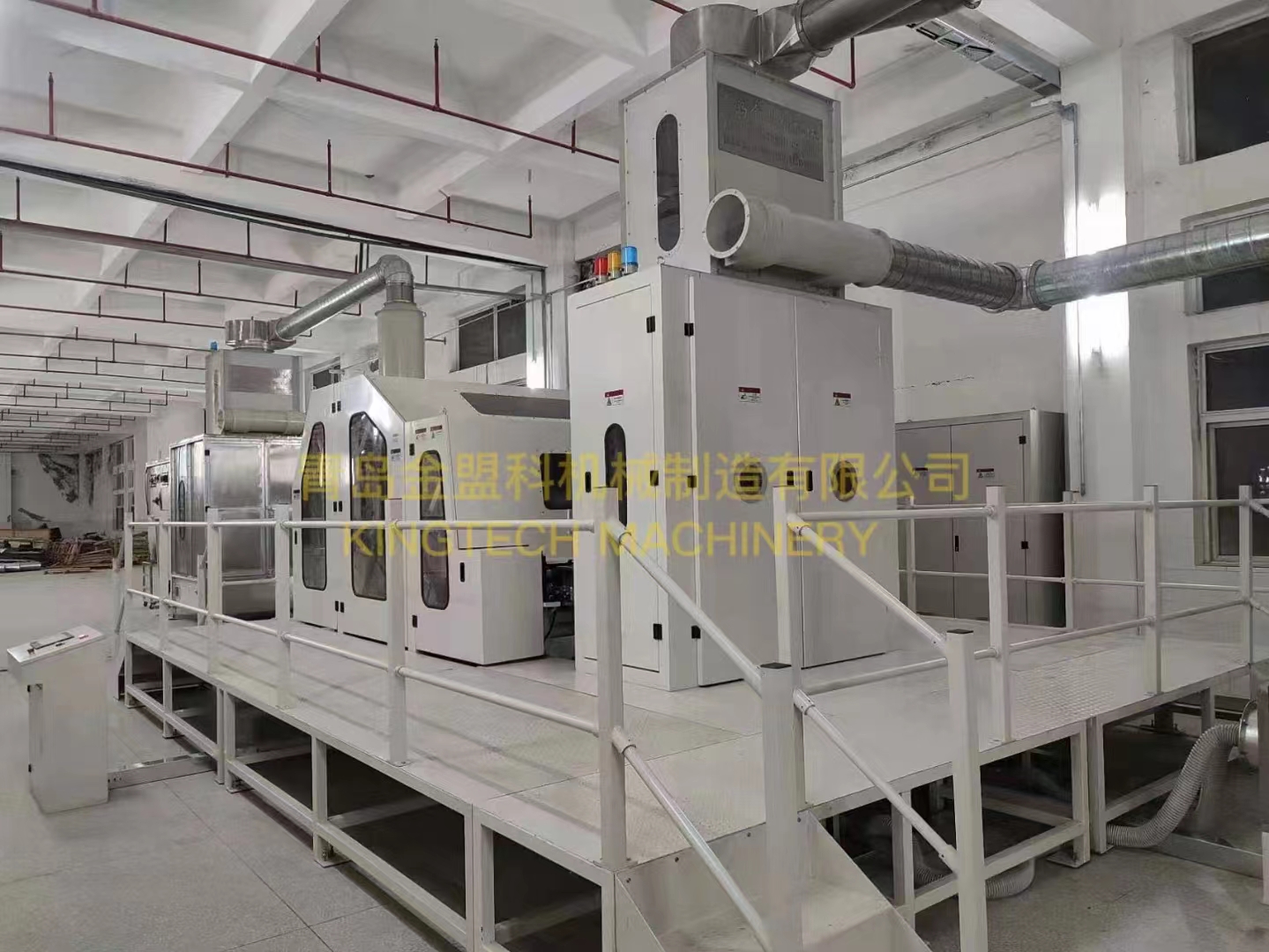
Kingtech Machinery provides several equipment options for different nonwoven waste conditions.
For clean and continuous production edge waste, the Edge Trim Opener is the most direct option. For thicker, denser, or more difficult textile waste, a Combined Opener System can provide multi-stage opening. When the recovered fiber needs better separation and uniformity, an Opening-Carding System can be added.
The suitable configuration depends on nonwoven type, waste form, fiber condition, and required output rather than treating all nonwoven materials as one category.
Conclusion
A Non Woven Recycling Machine should be selected according to how the nonwoven was originally made.
Spunbond, spunlace, needle-punched, air-through, thermal-bonded, and edge-trim waste all have different structures and therefore different recycling requirements. Some materials need gentle direct opening, while others benefit from gradual multi-stage opening or additional carding.
The most useful principle is simple:
Understand the nonwoven structure first, then decide how much opening and fiber refinement are actually needed.
FAQ
1. Can one Non Woven Recycling Machine process every type of nonwoven waste?
Not always. Different bonding and fiber structures can require different opening strength, feeding methods, and processing stages.
2. Which nonwoven waste is usually easier to recycle?
Clean production edge trims are generally easier to process because their material composition is known and they are more regular than mixed or post-use textile waste.
3. When is a Combined Opener System useful for nonwoven waste?
It is more suitable for thick, dense, compact, or difficult-to-open materials such as some needle-punched and multilayer nonwoven waste.
4. When should carding be added after nonwoven opening?
Carding is useful when the recovered fiber needs better separation and uniformity for nonwoven web formation, needle punching, air-laid applications, or other processes requiring stable fiber distribution.
Post time: Aug-20-2026