




A Garment Shredder can be an important part of textile waste recycling, but shredding is not always the first or best step for every garment waste stream. In some cases, material should be cut into manageable pieces before opening. In others, relatively clean and simple textile waste may be suitable for direct opening without aggressive size reduction. The correct route depends on the structure of the waste, the condition of the textile, and the fiber quality required after recycling.
This distinction is important because unnecessary shredding can increase small fragments and shorten usable fibers, while insufficient size reduction can create feeding problems or leave large textile structures difficult to open. A practical garment recycling process therefore needs to decide not only which machine to use, but also when shredding, cutting, or direct opening is the more suitable option.
Garment Waste Does Not Always Need the Same First Processing Step
Textile waste can enter a recycling line in very different physical forms. Large garments, compact fabric bundles, production offcuts, knitted scraps, and already-small cutting waste may all require different preparation.
A Garment Shredder is most useful when the original material is too large, irregular, or difficult to feed consistently into later equipment. Its main role is to reduce the material into a more manageable form before fiber separation.
However, if the waste is already relatively small and clean, an additional shredding stage may provide limited benefit. In that situation, the material may move directly into an opener or another fiber-recovery stage.
The key question is therefore not simply:“Can this material be shredded?” A more useful question is:“Does shredding solve a real processing problem before fiber recovery begins?”
Shredding, Cutting, and Opening Have Different Purposes
These three processes are often discussed together, but they perform different functions.
| Process | Main Purpose | Typical Use |
|---|---|---|
| Shredding | Reduces irregular or bulky textile waste into smaller pieces | Large or difficult garment waste |
| Cutting | Produces more controlled material size | Fabric waste needing stable feeding |
| Opening | Breaks textile structure into fiber form | Material already suitable for fiber separation |
Shredding mainly changes the physical size and shape of the waste. Cutting can provide more controlled piece size when material dimensions need to be reduced before opening. Opening goes further by breaking yarn and fabric structures so that fibers can be recovered.
Confusing these functions can lead to unnecessary processing. A shredder cannot replace proper fiber opening, while an opener should not always be expected to handle very large or irregular textile pieces directly.
When Is a Garment Shredder More Suitable?
A Garment Shredder becomes more useful when the incoming waste creates a size or handling problem.
Typical situations include:
- large or irregular textile pieces that cannot enter the opener steadily;
- dense garment waste that forms bulky bundles;
- mixed-size materials that create unstable feeding;
- textile waste that needs size reduction before further separation;
- production lines where the front-end material form changes frequently.
In these situations, shredding creates a more manageable feedstock for later equipment. The purpose is not to reduce the material to the smallest possible size, but to create a more controlled intermediate form.
Over-shredding should be avoided because extremely small pieces can increase fines, short fibers, and unnecessary fiber damage before the actual opening stage begins.
When Is Cutting More Suitable Than Shredding?
Cutting can be more suitable when the main problem is material length rather than material structure.For example, large fabric sheets, long strips, roll waste, or relatively flat garment waste may not need aggressive shredding. A cutting machine can reduce them into shorter pieces while preserving more of the original fiber structure.
This is especially useful when the next stage is opening. Controlled cutting can make feeding more stable without introducing excessive fragmentation.
The difference can be summarized simply:Shredding is useful for irregular bulk reduction; cutting is useful when more controlled size reduction is enough.
Choosing between the two should depend on the waste form rather than using the same front-end machine for every material.
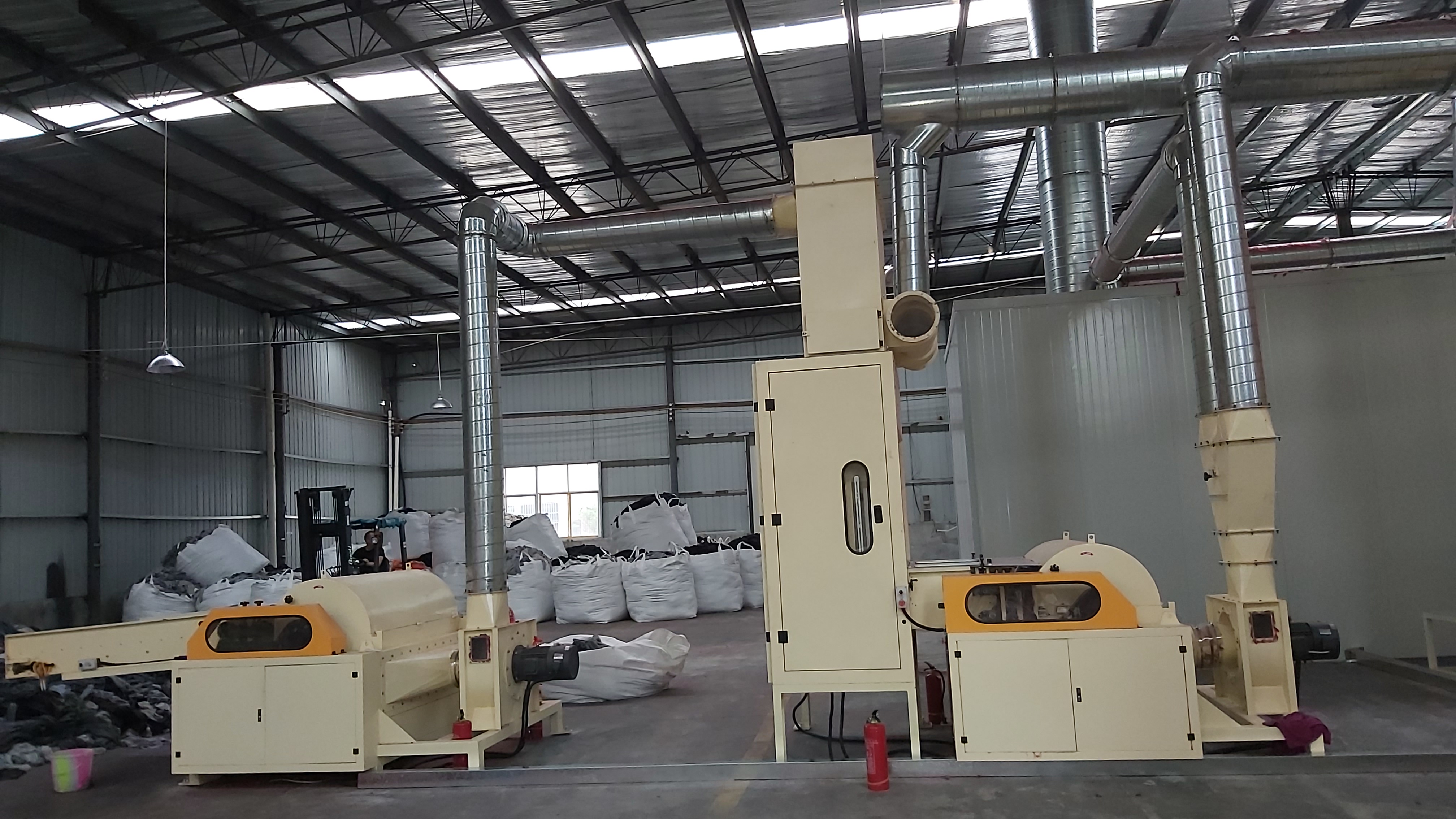
When Can Garment Waste Go Directly Into Opening?
Some textile waste does not need a separate shredding or cutting stage.
Relatively small garment production scraps, soft textile pieces, yarn-rich waste, or already-prepared fabric waste may be suitable for direct opening if the feeding system can handle the material consistently.
In this case, removing unnecessary size-reduction steps can help preserve more usable fiber length and simplify the recycling process.
Direct opening is more realistic when:
- material size is already manageable;
- textile structure is not excessively compact;
- feeding remains stable;
- hard foreign materials are limited;
- the opener is suitable for that material type.
This does not mean direct opening is always better. It simply means that every extra mechanical stage should have a clear purpose.
Why “More Processing” Does Not Automatically Mean Better Recycling
A common mistake in textile recycling is assuming that more machines and more processing stages automatically produce better fiber.
In reality, every mechanical stage affects the material.
Shredding reduces size but can also create fragments. Cutting improves handling but may generate additional edges and short pieces. Opening separates fiber structures but can shorten fibers if the action is too aggressive. Cleaning removes impurities but can also carry usable fibers away if overused.
For this reason, the best process is usually the shortest route that can reliably achieve the required fiber condition.
If the material can be opened directly, adding shredding may be unnecessary. If cutting solves the feeding problem, heavy shredding may not be needed. If the material remains too large or irregular, however, using a Garment Shredder before opening can improve the overall process.
A Simple Process Selection Framework
A useful way to decide the first processing step is to evaluate the incoming textile waste according to four factors.
1. Material Size
Large or bulky waste may need shredding or cutting before opening.
2. Material Shape
Long strips, sheets, and irregular garments behave differently during feeding. Their shape can determine whether controlled cutting or shredding is more suitable.
3. Textile Structure
Loose or lightly structured material may be easier to open directly, while dense woven or multilayer material may need more preparation.
4. Required Fiber Condition
If fiber length preservation is important, unnecessary front-end mechanical treatment should be reduced. If the priority is stable feeding and basic fiber recovery, stronger size reduction may be acceptable.
These factors can help avoid choosing equipment only by machine name.
How Front-End Processing Affects the Whole Recycling Line
The first processing stage has a direct influence on every machine that follows.
If the material remains too large, the opener may receive uneven loads. If the material becomes too fragmented, the opening stage may generate more fines and short fibers. If the front-end output varies greatly in size, downstream equipment may require more frequent adjustment.
A stable recycling line therefore depends on the condition of the material leaving the first machine.
The ideal front-end result is not “as small as possible.” It is:
- small enough to feed consistently;
- large enough to avoid unnecessary fiber damage;
- uniform enough for the next process;
- suitable for the intended opening method.
This is why choosing between shredding, cutting, and direct opening should be treated as a process decision rather than simply an equipment decision.
Kingtech Garment Waste Recycling Configurations
Kingtech Machinery provides different front-end and fiber-recovery equipment for garment waste, fabric scraps, and other textile materials.
For large or irregular waste that requires size reduction, cutting equipment can be used to prepare material before opening. For more difficult textile waste, Kingtech Combined Opener Systems can use multiple opening stages to gradually break down textile structures. When recovered fiber requires improved separation and uniformity, an Opening-Carding System can be added after opening.
The system can also integrate feeding, conveying, dust removal, metal detection, spark detection, and other auxiliary equipment according to the actual waste condition.
The purpose is not to force every garment waste stream through the same process. Instead, the front-end preparation and fiber-recovery stages can be matched according to material size, structure, feeding condition, and required fiber output.
Find the Right Processing Route for Your Garment Waste
If you are considering a Garment Shredder, the first step should be to determine whether shredding is actually necessary for your material.
You can provide Kingtech with information about the waste form, material size, textile structure, approximate processing volume, and the condition of fiber you expect after recycling. Photos, videos, or material samples can help determine whether the waste is more suitable for shredding, controlled cutting, direct opening, or a combined recycling process.
Contact Kingtech Machinery to discuss your garment waste and identify a suitable processing route before selecting the equipment configuration.
Conclusion
A Garment Shredder is useful when garment waste is too large, irregular, or difficult to feed into later recycling equipment, but shredding should not automatically be added to every recycling line.
Some materials are better prepared through controlled cutting, while others can move directly into opening. The right decision depends on material size, shape, structure, and the condition required from the recovered fiber.
A better recycling process does not necessarily use more machines. It uses the right process at the right stage, with enough preparation to stabilize production while avoiding unnecessary fiber damage.
FAQ
1. Does all garment waste need a Garment Shredder?
No. Some small or relatively simple textile waste can enter the opening stage directly, while larger or irregular materials may need shredding or cutting first.
2. What is the difference between shredding and cutting garment waste?
Shredding is generally used for irregular size reduction, while cutting can provide more controlled piece sizes with less unnecessary fragmentation.
3. Can garment waste go directly into an opener?
Yes, if the material size, structure, and feeding condition are suitable for the opener. Large or irregular waste may require front-end preparation first.
4. Can excessive shredding reduce recycled fiber quality?
Yes. Excessive size reduction can increase small fragments, fines, and fiber damage before the opening stage, especially when long usable fibers are important.
Post time: Sep-15-2026