




A Garment Waste Recycling Machine helps garment factories and textile recycling workshops turn cutting waste, fabric offcuts, rejected garment pieces, old clothes, and mixed cloth scraps into reusable fiber. In garment production, waste is not only created at the end of the process. It appears every day on cutting tables, beside sewing lines, during trimming, and after quality inspection.
For many factories, the problem is not simply that garment waste exists. The bigger issue is that waste fabric takes up space, requires manual collection, becomes mixed with different materials, and often loses value when it is not processed correctly. A better recycling process can help factories manage fabric waste more efficiently and recover usable fiber from materials that would otherwise be treated as disposal waste.
Cutting Waste Is a Daily Management Problem
In a garment factory, cutting waste is produced continuously. Small scraps, long strips, rejected panels, sleeves, collars, lining materials, and fabric edges may collect quickly during daily production. If these materials are not sorted or processed in time, they can create several problems.
Common problems include:
- Waste fabric piles up around work areas.
- Workers spend extra time moving and collecting scraps.
- Different fabric types become mixed together.
- Large pieces are difficult to store or transport.
- Valuable textile material becomes low-value waste.
- Later recycling becomes more difficult.
This is why garment waste recycling should not only be seen as an environmental topic. It is also part of factory material management and production efficiency.
Not All Garment Waste Has the Same Recycling Value
Garment waste from different sources has different reuse potential. Clean cutting scraps from new fabric are usually easier to process because the material type is more consistent. Used clothes, mixed rags, rejected garments, and sewn pieces are more complicated because they may contain seams, accessories, multilayer structures, or mixed fibers.
Garment waste can generally be divided into several types:
- Clean cutting scraps from production
- Long edge strips from trimming
- Rejected garment panels
- Used clothes and old textiles
- Cotton or polyester rags
- Knitted and woven fabric waste
- Mixed cloth scraps from workshop collection
For recycling, cleaner and more consistent waste usually produces better recovered fiber. Mixed or contaminated waste may still be reused, but it often requires more preparation before opening.
Why Garment Waste Cannot Be Reused Directly
Although garment waste is still textile material, it cannot usually be sent directly into new production. Large fabric pieces are difficult to feed into recycling equipment, old clothes may contain seams or accessories, and mixed materials may behave differently during opening.
If waste fabric is processed without preparation, factories may face:
- Uneven feeding
- Roller wrapping
- Machine blockage
- Poor opening effect
- More unopened pieces
- Less stable recycled fiber quality
A garment waste recycling machine helps solve these problems by preparing the material step by step. The goal is not only to reduce waste size, but to make the material suitable for fiber recovery.
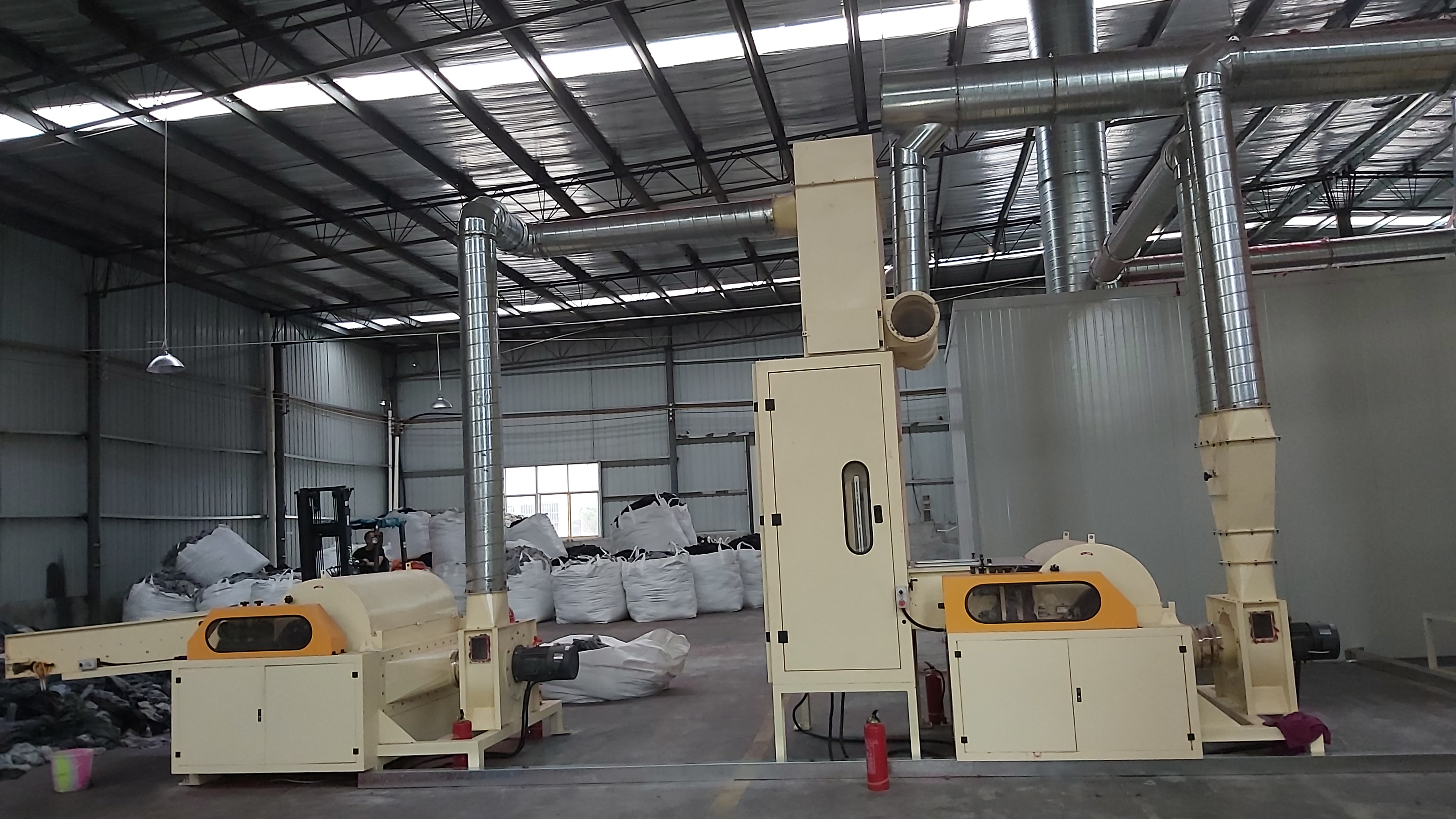
Turning Waste Fabric Into a Material Flow
A better way to understand garment waste recycling is to see it as a material flow. Waste fabric should move from collection to preparation, then to opening and fiber recovery. If one step is missing, the whole process becomes less stable.
A practical material flow may include:
- Collecting garment waste from cutting and sewing areas
- Sorting waste by fabric type or cleanliness
- Removing hard accessories when needed
- Cutting large pieces into smaller sizes
- Opening the textile structure into loose fiber
- Adding carding when more uniform fiber is required
- Collecting recycled fiber for reuse
This type of process makes garment waste easier to manage. Instead of random piles of fabric scraps, the factory creates a more organized recycling route.
The Role of Cutting Before Recycling
For garment waste, cutting is often the first practical step. It does not complete the recycling process, but it makes the following process easier. Large pieces, old clothes, long strips, and multilayer garment waste are usually more difficult to feed directly into an opener.
Cutting helps reduce the material into a more manageable size, which can improve feeding stability and reduce machine problems. It is especially useful for:
- Old clothes
- Long fabric offcuts
- Large garment panels
- Knitted fabric scraps
- Woven fabric waste
- Mixed cloth waste
- Thick or multilayer pieces
After cutting, the material can enter an opener or combined opener system more smoothly.
Opening Determines the Reuse Potential of Fiber
Once garment waste is cut into suitable sizes, opening becomes the key step. The opener loosens the textile structure and separates the fiber as much as possible. For simple cutting waste, one opener may be enough. For old clothes, rags, thick scraps, or mixed fabrics, a combined opener system may provide better results.
The opening process affects:
- Fiber looseness
- Amount of unopened pieces
- Fiber damage level
- Feeding stability for later processes
- Final reuse value of recovered fiber
If the recovered fiber needs better uniformity, carding can be added after opening. This is useful when the fiber will be used in nonwoven production, needle-punched products, filling materials, or other applications that require more stable fiber distribution.
What Recycled Garment Fiber Can Become
Recovered fiber from garment waste does not always return to clothing production. In many cases, it is reused in other textile or industrial applications where recycled fiber can provide practical value.
Common applications include:
- Filling material
- Mattress and cushion padding
- Furniture padding
- Needle-punched felt
- Nonwoven fabric production
- Cleaning cloth materials
- Automotive textile layers
- Insulation material
- Industrial textile products
The final application depends on the original fabric type, fiber condition, opening effect, and whether carding is used. Clean and consistent garment scraps usually have higher reuse potential, while mixed waste may be more suitable for filling, padding, insulation, or industrial use.
About Kingtech Machinery
Kingtech Machinery provides textile waste recycling equipment for different garment waste and fabric recycling needs. Its product range includes Cutting Machine, Combined Opener System, Opening-Carding System, Edge Trim Opener, Cotton Waste Recycling Line, laboratory recycling test lines, needle punching lines, blowers, metallic card clothing, and related accessories. For garment cutting waste, old clothes, rags, and mixed cloth scraps, suitable equipment can be combined according to material size, opening difficulty, required fiber quality, and final reuse application.
Conclusion
A Garment Waste Recycling Machine helps garment factories handle cutting waste, old clothes, rags, rejected panels, and mixed fabric scraps more efficiently. The value of this equipment is not only in reducing waste, but also in helping factories build a more organized material recovery process.
When garment waste is collected, sorted, cut, opened, and reused properly, it can become a usable fiber resource instead of a storage and disposal problem. For factories that produce fabric waste every day, a suitable recycling process can improve waste management, reduce material loss, and create more value from leftover textile materials.
FAQ
1. What is a Garment Waste Recycling Machine used for?
A Garment Waste Recycling Machine is used to process garment cutting waste, old clothes, rags, rejected garment pieces, and mixed fabric scraps into reusable fiber.
2. Why is garment cutting waste difficult to recycle directly?
Garment waste may be large, tangled, stitched, layered, or mixed with different fibers. Without cutting and opening, it may cause unstable feeding, blockage, and poor fiber recovery.
3. Can garment waste be turned into fiber again?
Yes. With proper sorting, cutting, opening, and sometimes carding, garment waste can be turned into recycled fiber for filling, nonwoven production, needle-punched products, and industrial textile applications.
4. Which machines are usually used for garment waste recycling?
A practical system may include a cutting machine, opener, combined opener system, opening-carding system, and fiber collection equipment, depending on the material condition and final use.
Post time: Jul-28-2026