




In today’s textile recycling and nonwoven processing industry, manufacturers are under increasing pressure to improve fiber recovery efficiency while maintaining high output quality. Traditional single-machine recycling methods often struggle to handle complex materials such as spunlace fabrics, air-through nonwovens, wool blends, aramid fibers, and mixed yarn waste. To solve this challenge, a new generation of recycling solution has been developed: the Opening and Carding System.
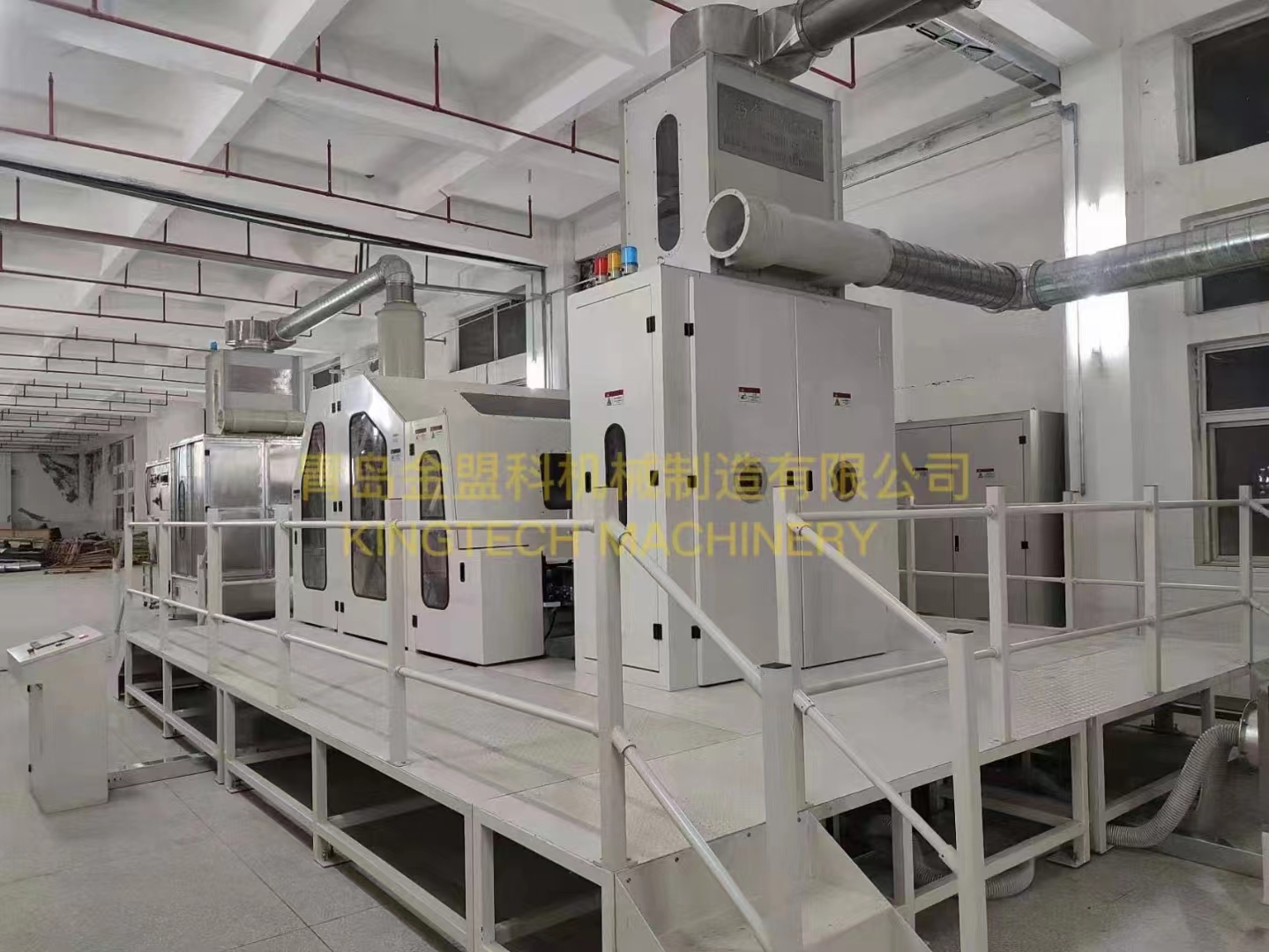
This system integrates multiple opening units and carding machines into a complete production line, allowing controlled fiber opening, refining, and alignment in a continuous process. It is widely used in industrial fiber recycling where both fiber quality and production capacity are critical.
Why Is a Combined Opening and Carding System Needed in Fiber Recycling?
In many recycling operations, raw materials are not uniform. Waste fabrics, yarn waste, and technical textiles often contain tightly bonded fibers, mixed structures, and high-strength synthetic components. A single processing step is not enough to fully open and refine these materials.
A combined system solves this limitation by dividing the process into multiple controlled stages, improving both fiber quality and production stability.
Key industry challenges include:
● Mixed textile waste with different fiber structures
● High-strength materials such as aramid and technical fibers
● Low fiber length retention in traditional single-machine systems
● Inconsistent output quality in recycled fiber production
● Limited production capacity in conventional recycling setups
The opening and carding combination directly addresses these limitations.
What Is an Opening and Carding System and How Does It Work?
An Opening and Carding System is a complete fiber recycling production line composed of opener machines and carding machines. Depending on material requirements, the system can include one, two, or three opening machines followed by one or two carding units working in sequence.
Each stage plays a specific role in fiber transformation, ensuring gradual and controlled processing.
System workflow includes:
● Initial opening stage to loosen compacted waste materials
● Secondary or multi-stage opening for deeper fiber separation
● Controlled feeding into carding units for fiber alignment
● Carding process to refine fiber structure and improve uniformity
● Output of long, fine, and reusable fibers for industrial use
This staged structure improves both fiber quality and processing efficiency.
What Materials Can Be Processed in This System?
One of the strongest advantages of this system is its ability to handle a wide range of industrial and textile waste materials. It is designed for complex fiber structures that cannot be processed effectively by simple shredding or single-opening machines.
Applicable materials include:
● Spunlace nonwoven fabrics
● Air-through nonwoven materials
● Wool fabrics and blended textiles
● Aramid fiber industrial waste
● Yarn waste from spinning processes
● Hemp and jute natural fiber materials
● Mixed textile production waste
This versatility makes it suitable for multiple recycling industries.
Why Multi-Stage Opening Improves Fiber Quality
In fiber recycling, the number of opening stages directly affects final fiber quality. A single opening process may leave fiber clusters intact or damage fiber length. Multi-stage opening gradually reduces fiber density while preserving structure.
This controlled approach improves the final output significantly.
Key advantages of multi-stage opening:
● Better fiber separation without excessive damage
● Improved fiber length retention for high-value applications
● More uniform fiber distribution in final output
● Reduced fiber entanglement and clumping
● Higher consistency in industrial-grade recycled fibers
These improvements are essential for producing high-performance recycled materials.
Role of Carding in Fiber Refinement
After opening, fibers still require alignment and refinement before they can be reused effectively. This is where the carding system plays a critical role. Carding helps organize fibers into a more uniform structure, improving usability in downstream applications.
Carding functions include:
● Aligning fibers into parallel or semi-parallel structure
● Removing remaining impurities and short fiber fragments
● Improving fiber uniformity and distribution
● Preparing fibers for nonwoven or textile reuse
● Enhancing mechanical properties of recycled output
The combination of opening and carding ensures higher-grade fiber output.
Flexible System Configuration Based on Production Needs
One of the key design advantages of this system is its flexibility. Manufacturers can choose different configurations depending on raw material conditions and production capacity requirements.
Typical configurations include:
● Single opener + single carder for standard waste processing
● Double opener + single carder for medium complexity materials
● Triple opener + double carder for high-demand industrial recycling
● Customized line combinations for special fiber types
This flexibility allows factories to scale production based on actual demand.
Working Width Options for Industrial Applications
To meet different factory layouts and production capacities, the system is available in multiple working width configurations.
Available working widths include:
● 1000 mm for small to medium production lines
● 1500 mm for standard industrial applications
● 2000 mm for high-capacity recycling systems
● 2500 mm for large-scale continuous production
This range ensures compatibility with different plant sizes and output requirements.
Industrial Applications of Recycled Fibers
Fibers produced by the Opening and Carding System are not low-grade materials. Instead, they are high-quality recycled fibers that can be used in various industrial sectors.
Main application industries include:
● Nonwoven fabric production
● Automotive interior materials such as insulation and padding
● Filtration materials for air and liquid systems
● Industrial felt and technical textiles
● Furniture filling and cushioning materials
● Protective and functional textile products
These applications require stable fiber quality, which this system is designed to provide.
Why This System Improves Production Efficiency
Compared to traditional recycling systems, the integrated opening and carding line significantly improves overall efficiency by reducing manual handling and improving automation.
Efficiency improvements include:
● Continuous production without frequent material interruption
● Higher fiber output per unit of raw waste
● Reduced energy loss through optimized processing stages
● Lower labor dependency in recycling operations
● Stable and predictable production quality
This makes it suitable for large-scale industrial recycling facilities.
Future Development of Opening and Carding Technology
As industrial recycling becomes more advanced, opening and carding systems are also evolving toward smarter and more automated solutions.
Future trends include:
● Intelligent control systems for real-time adjustment
● Automated feeding and material distribution
● Energy-efficient motor and mechanical design upgrades
● Integration with smart factory production systems
● Enhanced fiber protection and quality monitoring
These innovations will further improve recycling performance and operational stability.
Conclusion
A modern Opening and Carding System provides a complete and efficient solution for industrial fiber recycling. By combining multi-stage opening with precision carding, it enables manufacturers to process complex textile waste into long, fine, and reusable fibers with high consistency.
For industries dealing with spunlace, air-through fabrics, wool blends, aramid fibers, and yarn waste, this system represents a significant upgrade in both production capability and fiber quality control. It supports large-scale recycling while improving resource utilization and reducing operational costs.
FAQ
1. What is the main function of an opening and carding system?
Its main function is to open fiber waste into loose form and then card it into uniform, usable fibers for industrial applications.
2. What materials can be processed?
It can process spunlace, air-through nonwovens, wool fabrics, aramid fibers, yarn waste, hemp, jute, and mixed textile waste.
3. Why are multiple opening stages needed?
Multiple stages improve fiber separation gradually, helping preserve fiber length and improve final output quality.
4. What is the advantage of combining opening and carding?
The combination ensures both fiber loosening and fiber alignment, producing higher-quality recycled fibers suitable for industrial reuse.
Post time: Jun-18-2026