




In textile recycling and recycled fiber production, disordered waste fabric is one of the most difficult materials to process efficiently. Many factories face the same problem: traditional opening solutions cannot fully process messy fabric waste, which often results in small fabric pieces, unopened fiber bundles, and uneven output quality.
For spunlace cloth makers, air-through cloth makers, and other nonwoven manufacturers, this challenge becomes even more serious because they require clean, well-opened, and consistent fibers for stable production. To solve this problem, the New Design Opening-Carding System is developed for roll-form materials that are no longer neatly rolled, but instead appear in loose, tangled, or disordered conditions.
Why Disordered Waste Fabric Is Difficult to Process
In many textile and nonwoven factories, production waste is not always clean, flat, or organized. Although some materials originally come in roll form, they often become unrolled, compressed, twisted, or mixed during storage, handling, and recycling collection. This creates major challenges for traditional recycling equipment.
Traditional opening machines usually perform well when the input material is relatively uniform, but disordered waste fabric behaves differently during processing. It may enter the machine unevenly, wrap around rollers, or remain partially unopened after treatment.
Common problems caused by disordered waste fabric include:
● Irregular feeding due to tangled or loose material structure
● Incomplete opening of fabric layers and fiber bundles
● Small fabric pieces remaining in the output fiber
● Uneven fiber quality affecting downstream production
● Higher equipment load and unstable processing efficiency
● Increased need for repeated processing steps
These problems reduce the value of recycled fiber and make it difficult for manufacturers to meet higher quality requirements.
Limitations of Traditional Opening Solutions
Old model solutions are often based on simple opening or tearing principles. They can reduce material size, but they may not fully separate fibers when the fabric is messy, layered, or tightly entangled. As a result, the output fiber may still contain unopened material, which becomes a serious issue in high-quality recycled fiber production.
When customers require cleaner and more uniform fiber, factories may try to add more processing units. However, this method creates another problem: repeated mechanical processing can shorten fiber length and reduce fiber strength.
Traditional solutions often face these limitations:
● Unable to completely open disordered fabric waste in one smooth process
● Output may contain small fabric pieces or unopened fiber blocks
● More processing stages may be required to improve opening effect
● Repeated processing can reduce fiber length and lower fiber value
● Production efficiency may decrease due to unstable material feeding
● Final fiber quality may still fail to meet high-end production needs
For manufacturers that need reliable fiber quality, this creates a gap between production demand and traditional machine capability.
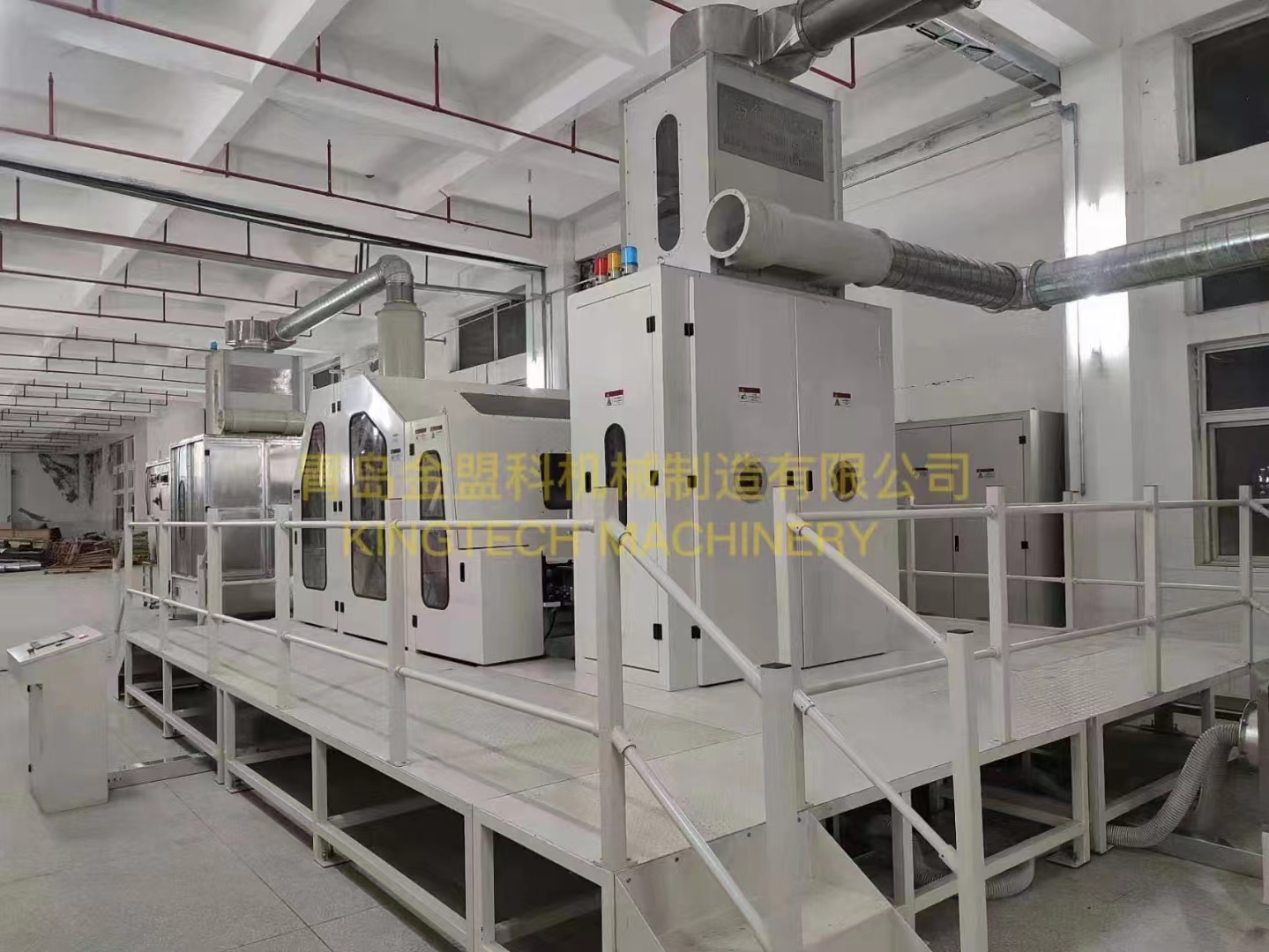
New Design Opening-Carding System: A Targeted Solution
The New Design Opening-Carding System is developed specifically to handle waste fabric in disordered, unrolled, and tangled conditions. Instead of only tearing the material, this system combines controlled opening and carding processes to improve fiber separation, reduce unopened material, and support more uniform output.
This system is especially suitable for spunlace and air-through cloth manufacturers because these industries often generate roll-form production waste that becomes loose or disordered before recycling. In the past, there were limited machine solutions available in the market that could process this type of material effectively.
The system is designed to process:
● Spunlace nonwoven waste
● Air-through nonwoven waste
● Roll-form fabric waste in unrolled condition
● Disordered textile production waste
● Soft nonwoven scraps and edge materials
● Loose, tangled, or uneven fabric materials
By focusing on this specific material condition, the system provides a more practical solution for factories that cannot achieve stable results with old model equipment.
How the Opening-Carding System Improves Fiber Quality
The key advantage of the New Design Opening-Carding System is that it does not rely only on strong mechanical tearing. Instead, it uses a more balanced process to gradually open, separate, and organize the fibers. This helps reduce the chance of leaving small fabric pieces in the final output.
Carding also plays an important role in improving fiber uniformity. After the initial opening process, the carding section further separates fibers and reduces clumps, making the output more suitable for high-quality recycled fiber applications.
Fiber quality improvements include:
● Better separation of fabric layers and fiber bundles
● Fewer small fabric pieces in the final output
● Reduced unopened fiber blocks
● More uniform fiber distribution
● Better preparation for downstream nonwoven production
● Improved stability in recycled fiber applications
For customers who require higher-quality fiber, this system provides a more reliable processing route.
Why Fiber Length Protection Matters
In recycled fiber production, fiber length is directly related to material value and downstream performance. If the recycling process is too aggressive or requires too many repeated processing units, fiber length may decrease significantly. Shorter fibers may affect web formation, bonding performance, softness, strength, and overall product stability.
The New Design Opening-Carding System is designed to improve opening efficiency while reducing unnecessary repeated processing. By achieving better fiber separation in a more controlled process, it helps protect fiber length and maintain higher material value.
Benefits of fiber length protection include:
● Higher recycled fiber value
● Better performance in nonwoven production
● More stable fiber blending
● Reduced fiber damage during processing
● Improved final product consistency
● Lower risk of quality fluctuation
This is especially important for spunlace and air-through cloth producers, where fiber quality has a direct impact on product appearance, softness, and production stability.
Designed for Spunlace and Air-Through Cloth Makers
Spunlace and air-through cloth manufacturers often deal with large volumes of production waste, edge trims, rejected rolls, offcuts, and leftover materials. Although these materials may originally be in roll form, they are often not neatly rolled after collection or handling. They may become loose, folded, compressed, or tangled, making them difficult to feed and open with standard machines.
The New Design Opening-Carding System is developed around this real production situation. It is not just a general textile recycling machine; it is designed for the practical challenges faced by nonwoven manufacturers.
Typical user scenarios include:
● Spunlace factories processing rejected roll waste
● Air-through cloth makers recycling production scraps
● Nonwoven plants handling loose and disordered roll-form materials
● Recycling workshops processing soft fabric waste
● Manufacturers seeking higher fiber quality from waste material
This makes the system especially valuable for factories that want to turn difficult waste into usable recycled fiber.
Applications of the Processed Fiber
The fiber processed by the New Design Opening-Carding System can be used in multiple recycled textile and nonwoven applications, depending on raw material type and output requirements.
Common application directions include:
● Recycled fiber blending
● Nonwoven material production
● Filling material processing
● Industrial textile applications
● Cleaning cloth and wiping material production
● Recycled textile product development
Because the system improves fiber opening and uniformity, it helps create more value from waste fabric that was previously difficult to process.
Conclusion
Disordered waste fabric has long been a difficult problem in textile recycling, especially for spunlace and air-through cloth makers that handle roll-form materials in loose, unrolled, or tangled conditions. Traditional solutions often cannot fully process these materials, leaving small fabric pieces or unopened fiber in the output. When more processing units are added, fiber length may decrease, reducing the value of the recycled material.
The New Design Opening-Carding System provides a targeted solution for this challenge. By combining controlled opening and carding technology, it improves fiber separation, reduces unopened material, protects fiber length, and supports higher-quality recycled fiber production. For B2B manufacturers seeking stable processing and better fiber output, this system offers a practical path toward more efficient and valuable textile waste recycling.
FAQ
1. What problem does the New Design Opening-Carding System solve?
It is designed to process disordered, unrolled, and tangled waste fabric that traditional opening machines may not fully handle, reducing small fabric pieces and unopened fiber in the output.
2. Why is this system suitable for spunlace and air-through cloth makers?
These manufacturers often generate roll-form production waste that becomes loose or disordered during handling, and this system is developed specifically for that type of difficult material condition.
3. How does the system help protect fiber length?
By improving opening efficiency and reducing the need for repeated processing stages, the system helps minimize excessive fiber damage and maintain better fiber length.
4. What kind of output quality can the system improve?
It helps produce more uniform, better-opened fibers with fewer unopened blocks, making the recycled material more suitable for downstream nonwoven and fiber recycling applications.
Post time: May-14-2026