




In today’s textile and nonwoven industries, the efficiency and quality of fiber preparation directly determine the performance of the final product. The Opening Carding System plays a crucial role in transforming raw materials into uniform fiber webs, making it an essential part of any high-quality production line. Whether processing virgin fibers or recycled materials, a well-designed system significantly improves consistency and overall productivity.
As demand continues to grow for high-performance nonwovens, sustainable recycled fibers, and technical textiles, the Opening Carding System has become a key solution for upgrading modern manufacturing lines.
Basic Structure and Working Principle of Opening Carding System
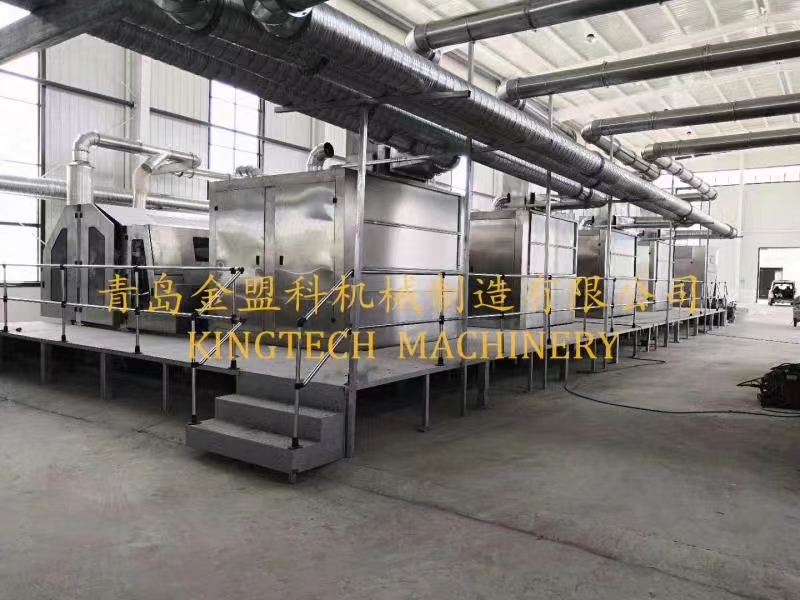
An Opening Carding System typically consists of opening units (openers), carding machines (carders), and auxiliary systems such as feeding, conveying, and cleaning units. The entire process operates continuously, converting compressed raw materials into uniform fiber webs.
● Opening Stage
Mechanical forces are used to loosen compressed or entangled fibers, breaking them into smaller, evenly distributed tufts to prepare for further processing.
● Carding Stage
High-speed carding cylinders and wire clothing separate, align, and orient fibers, forming a consistent and uniform fiber web.
● Conveying and Control System
Ensures stable material flow between each stage, preventing blockages and uneven feeding.
● Cleaning and Dust Removal System
Removes dust, short fibers, and impurities to enhance final product quality.
Flexible Configurations for Different Materials
One of the key strengths of an Opening Carding System is its modular design, allowing flexible configurations based on raw material conditions.
● Single Opener + Single Carder
Suitable for relatively clean and uniform synthetic fibers, offering stable and efficient performance.
● Double Opener + Single Carder
Ideal for medium-complexity materials such as blended fibers or partially recycled inputs.
● Triple Opener + Double Carder
Designed for highly entangled or recycled materials such as yarn waste, hemp, or jute, ensuring thorough opening and precise carding.
This flexibility allows manufacturers to balance production efficiency with fiber protection.
Multiple Working Width Options for Scalable Production
The system is available in various working widths to meet different production capacities:
● 1000 mm — Suitable for small-scale or laboratory production
● 1500 mm — Ideal for medium-sized operations
● 2000 mm — Standard industrial configuration
● 2500 mm — Designed for large-scale, high-output production
A wider working width directly increases throughput, making it suitable for mass production environments.
Typical Applications of Opening Carding System
The Opening Carding System is widely used across multiple fiber processing industries due to its versatility.
● Spunlace Nonwoven Fabrics
Used in wipes, medical materials, and hygiene products where uniform fiber distribution is critical.
● Air-Through Nonwovens
Common in hygiene and filtration applications requiring stable fiber structures.
● Wool and Textile Processing
Maintains fiber softness and length, improving fabric quality.
● Aramid and High-Performance Fibers
Suitable for protective and industrial applications requiring precision processing.
● Recycled Fibers and Yarn Waste
Supports fiber reuse, improving sustainability and material efficiency.
● Hemp and Jute Fibers
Handles natural fibers effectively while preserving their structural integrity.
Key Advantages of Opening Carding System
In practical production environments, the system offers significant technical and operational benefits.
● Improved Fiber Uniformity
Ensures consistent product quality and reduces defects.
● Higher Production Efficiency
Continuous operation minimizes downtime and maximizes output.
● Reduced Fiber Damage
Gentle processing helps maintain fiber length and strength.
● Lower Material Waste
Optimized processing increases usable fiber yield.
● Broad Material Compatibility
Handles both virgin and recycled fibers efficiently.
Why Opening Carding System Is Essential in Production
In textile and nonwoven manufacturing, poor fiber preparation can lead to uneven thickness, weak structures, and inconsistent product quality. These issues are difficult to correct in later stages.
The Opening Carding System ensures fibers are properly opened and aligned before entering downstream processes, improving product stability and reducing rejection rates.
Integration with Complete Production Lines
The Opening Carding System is typically installed at the front end of a full production line and integrates seamlessly with downstream equipment:
● Spunlace production lines
● Air-through bonding systems
● Needle punching lines
This integration ensures smooth material flow and consistent production performance throughout the process.
Conclusion
The Opening Carding System is a fundamental component in modern fiber processing, enabling efficient transformation of raw materials into high-quality fiber webs. With flexible configurations, multiple working width options, and wide application compatibility, it supports both small-scale operations and large industrial production.
By improving fiber uniformity, reducing waste, and enhancing efficiency, the Opening Carding System plays a critical role in achieving stable, high-quality output in today’s competitive textile and nonwoven industries.
FAQ
- What materials can an Opening Carding System process?
It can process synthetic fibers, wool, aramid fibers, recycled fibers, yarn waste, hemp, and jute. - How to choose the right configuration?
The configuration depends on material complexity and production requirements. More complex materials require multiple opening and carding stages. - How does working width affect production?
A wider working width increases production capacity and is suitable for large-scale manufacturing. - Can it process recycled fibers?
Yes, the system is highly effective in processing recycled fibers and improving material utilization.
Post time: Apr-17-2026