




A Waste Fiber Recycling Machine can process many kinds of textile waste, but not every material should enter the recycling line in the same condition. Loose fiber waste, yarn waste, clean fabric scraps, old garments, nonwoven edge trims, coated fabrics, and mixed textiles all differ in structure, contamination, size, and fiber composition.
The key question is therefore not simply whether a material is “textile waste.” Before it enters a Waste Fiber Recycling Machine, it should be classified according to how much preparation it needs. Some waste can go directly into opening or carding, some needs cutting or sorting first, while coated, contaminated, or composite materials may require separate evaluation.
A simple classification system can prevent unsuitable material from entering the line and makes it easier to match the waste with the correct recycling process.
How Should Waste Be Classified Before Entering a Waste Fiber Recycling Machine?
Textile waste can be divided into three practical groups:
- Direct recycling: clean, loose, and relatively consistent materials that require little preparation.
- Pre-treatment required: materials that need cutting, sorting, accessory removal, or pre-opening before fiber recovery.
- Separate evaluation: coated, laminated, heavily contaminated, or highly mixed materials whose recyclability cannot be judged from appearance alone.
The table below gives a practical reference.
| Textile Waste | Direct Recycling? | Main Issue | Recommended Preparation |
|---|---|---|---|
| Loose fiber waste | Usually yes | Already close to fiber form | Direct opening or carding |
| Roving waste | Often yes | Compaction or fiber bundles | Controlled opening |
| Yarn waste | Usually not directly | Twist, knots, tangling | Opening, carding if needed |
| Clean fabric scraps | Depends | Fabric structure and piece size | Cutting or opening |
| Old garments | Usually no | Seams, accessories, multilayer parts | Sorting + cutting |
| Nonwoven edge trims | Often yes | Continuous feeding | Edge-trim opening |
| Thick needle-punched waste | Usually needs preparation | Dense structure | Size reduction + multi-stage opening |
| Coated or laminated fabric | Not directly | Non-fiber layers | Separate material test |
| Wet or heavily contaminated waste | Usually no | Moisture and contamination | Cleaning, drying, or rejection |
| Mixed textile waste | Depends | Different fibers and structures | Sorting and trial processing |
This classification is more useful than treating every waste material as suitable for one universal recycling line.
Group A: Waste That Can Often Enter Fiber Recycling Directly
The easiest materials to recycle are usually clean production wastes with a known composition and a relatively loose structure.
Examples include loose fiber waste, some roving waste, and clean continuous nonwoven edge trims. These materials already have fewer structural barriers between the original waste and reusable fiber.
For this group, the main goals are usually:
- Maintain stable feeding
- Separate remaining fiber bundles
- Avoid unnecessary fiber damage
- Keep the output uniform
- Prepare the fiber for its next application
Adding aggressive cutting or repeated opening to already-loose material may provide little benefit and can increase short-fiber generation.
Group B: Waste That Needs Pre-Treatment
Many textile wastes contain usable fiber but are not ready to enter the main recycling stage directly.
Fabric scraps are a typical example. The fibers are still locked inside woven or knitted structures. Large pieces may need cutting before opening, especially when they are thick, long, or irregular.
Old garments need even more preparation because they may contain:
- Buttons and zippers
- Metal accessories
- Thick seams
- Elastic components
- Linings
- Multilayer areas
- Mixed fiber compositions
Yarn waste belongs to this group for a different reason. It may be clean, but twist and tangling keep the fibers together. The main preparation is therefore controlled opening rather than strong cutting.
The important point is that pre-treatment should solve the specific problem of the material. Cutting is useful for oversized fabric, but it does not solve yarn twist. Sorting helps mixed garments, but it may be unnecessary for clean single-material production waste.
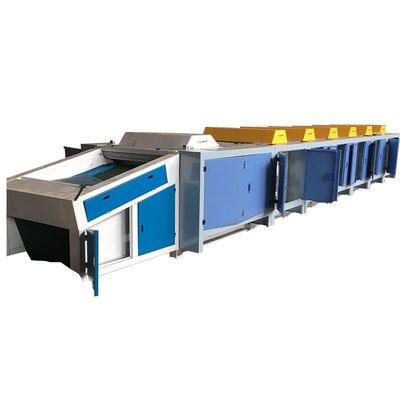
Group C: Waste That Needs Separate Evaluation
Some textile waste should not be fed directly into a Waste Fiber Recycling Machine, even if the base fabric contains recoverable fibers.
Coated and laminated textiles are common examples. The fabric may contain polyester, cotton, or other useful fibers, but attached PVC, adhesive, film, rubber, foam, or coating can remain mixed with the fiber after mechanical opening.
Heavily contaminated materials can create similar problems. Oil, excessive moisture, dirt, foreign materials, or unknown chemical residues may affect equipment operation and recovered fiber cleanliness.
These materials should be checked for:
- Type of coating or attached layer
- Ease of separation
- Contamination level
- Effect on machine components
- Non-fiber material remaining after opening
- Suitability of the recovered fiber for its intended use
A small trial is often more useful than assuming that every fabric containing valuable fiber can enter the same recycling process.
Why Waste Size Alone Is Not Enough to Judge Recyclability
A small piece of textile waste is not automatically ready for fiber recycling.
For example, a small piece of coated fabric may be more difficult to recycle than a large piece of clean cotton cloth. Likewise, short yarn pieces may still contain strong twist and knots even though their physical size is already small.
A better evaluation considers four factors together:
Structure + composition + contamination + waste form
Size matters mainly when it affects feeding and opening. It should not be used as the only criterion for deciding whether material can enter the recycling line.
Five Checks Before Feeding a Waste Fiber Recycling Machine
Before material enters the main recycling process, five quick checks can prevent many common problems.
Check the Fiber Composition
Known and consistent materials are easier to process. Mixed fibers may still be recyclable, but the recovered material will also contain a mixed composition unless another separation process is used.
Check for Hard Parts
Metal, large zippers, hooks, buttons, or other hard accessories should be identified before processing because they may damage opening components.
Check the Textile Structure
Loose fibers, yarn, woven fabric, knitted fabric, and nonwoven waste do not require the same processing route.
Check for Coatings and Contamination
Coatings, adhesive layers, dirt, oil, and moisture can affect both equipment operation and fiber quality.
Check the Final Fiber Requirement
Fiber for filling does not need exactly the same preparation as fiber intended for nonwoven, needle-punching, or more uniform downstream feeding.
These five checks provide a practical starting point for configuring a Waste Fiber Recycling Machine.
How to Know Whether Pre-Treatment Is Sufficient
The result after the first processing stage can also help determine whether the preparation is appropriate.
Useful signs include:
- Material feeds continuously without wrapping
- Large hard parts have been removed
- Oversized fabric pieces no longer dominate the feed
- Fiber bundles can be opened gradually
- No obvious coating contamination appears in the output
- The next machine receives material at a relatively stable rate
If large fabric pieces, knots, hard accessories, or composite fragments remain, the material may need more preparation before the main fiber-recovery stage.
Matching Different Waste to Kingtech Equipment
Kingtech Machinery provides different textile waste recycling equipment for materials that require different levels of preparation.
For large fabric scraps and old textile pieces, a Cutting Machine can reduce material size before opening. For complex cloth waste, rags, and materials that need gradual separation, a Combined Opener System can provide multi-stage opening. Yarn waste, roving, and materials requiring better fiber uniformity can be processed with an Opening-Carding System, while clean continuous nonwoven edge trims can be handled with an Edge Trim Opener.
The equipment route should therefore follow the material condition instead of forcing every waste type through the same configuration.
Conclusion
A Waste Fiber Recycling Machine works best when textile waste is correctly classified before processing.
The most practical approach is to divide material into three groups:
- Direct recycling for clean, loose, consistent waste
- Pre-treatment required for yarn, fabric scraps, old garments, and compact textile waste
- Separate evaluation for coated, laminated, contaminated, or highly mixed materials
The most important question is not simply whether the material contains recoverable fiber. It is whether the material enters the recycling process in a condition that allows the fiber to be separated without unnecessary damage, contamination, or equipment problems.
FAQ
1. What textile waste can usually enter a Waste Fiber Recycling Machine directly?
Loose fiber waste, some roving waste, and clean continuous nonwoven edge trims often require relatively little preparation before opening or carding.
2. Why do old clothes usually need pre-treatment?
Old garments may contain seams, zippers, buttons, elastic parts, linings, and different fabric structures. Sorting and cutting can make the following recycling stages more stable.
3. Can coated textile waste be mechanically recycled?
Some coated materials may contain recoverable fiber, but coatings, films, adhesives, or other layers can remain mixed with the fiber. These materials should be evaluated separately before full-scale processing.
4. What should be checked before textile waste enters a recycling line?
The most useful checks are fiber composition, textile structure, hard accessories, contamination or coatings, and the required condition of the recovered fiber.
Post time: Aug-27-2026