




An Old Clothes Recycling Machine is designed to process used clothing, rags, rejected garments, and mixed textile waste into reusable fiber. Unlike clean cutting scraps, old clothes often contain different fabrics, seams, elastic parts, linings, buttons, zippers, and multilayer sections. These differences make old clothing more difficult to process and place higher requirements on material preparation, feeding, opening, and fiber separation.
A suitable Old Clothes Recycling Machine does more than reduce the size of used garments. Depending on the material condition, the recycling process may include cutting, multi-stage opening, and carding. Large garments may need size reduction before opening, while mixed or thick materials often require more controlled opening to reduce unopened pieces and improve fiber looseness.
How Does an Old Clothes Recycling Machine Handle Complex Garment Waste?
An Old Clothes Recycling Machine needs to deal with much more than ordinary fabric pieces. A single garment may contain several materials and structures, which react differently during cutting and opening.
Typical difficult parts include:
- Collars, cuffs, waistbands, and thick seams
- Buttons, zippers, buckles, and metal accessories
- Linings and interlinings
- Elastic bands
- Printed or coated areas
- Knitted, woven, and denim fabrics
- Cotton, polyester, and blended fibers
Light fabric may open quickly, while thick seams can remain in pieces. Knitted materials may stretch or wrap during feeding, and hard accessories may damage rollers or metallic wire. For this reason, the performance of an Old Clothes Recycling Machine depends not only on the opening unit itself, but also on sorting, size reduction, and material preparation before opening.
What Should Be Checked Before Old Clothes Enter the Machine?
Before used garments enter the recycling line, materials that may affect equipment operation or recycled fiber quality should be identified first.
Important checks include:
- Removing obvious metal parts, large zippers, and hard accessories
- Separating heavily contaminated or damp textiles
- Checking thick multilayer sections
- Separating very different material groups when possible
- Reducing oversized garments before continuous feeding
These steps help an Old Clothes Recycling Machine maintain more stable feeding and reduce blockage, abnormal wear, and contamination in the recovered fiber.
Why Cutting Is Often Needed Before Opening
Large garments are difficult to feed directly into an opener. Jackets, trousers, long sleeves, denim pieces, and multilayer clothing can enter unevenly or wrap around rollers.
A Cutting Machine reduces the garment into smaller pieces before opening. Its purpose is not to produce fiber directly, but to improve material feeding.
Cutting can help:
- Reduce large garments into manageable sizes
- Prevent long fabric from wrapping around rollers
- Improve feeding continuity
- Reduce sudden machine load
- Make thick and mixed materials easier to open
For light and already-small textile waste, cutting may not be necessary. For large old clothes, however, it is often an important preparation step.
When Is a Combined Opener System More Suitable?
After size reduction, the material needs to be opened so that the textile structure gradually returns to a loose fiber state.
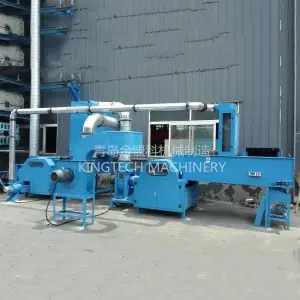
A single opener can work well for simple, soft, and relatively consistent material. Old clothes are often more complex, so a Combined Opener System may provide a more stable result.
Instead of relying on one strong opening stage, multiple opening units loosen the material gradually. This can help:
- Reduce unopened fabric pieces
- Handle thick seams and compacted cloth
- Improve fiber looseness
- Process mixed knitted and woven materials
- Reduce the load on one opening unit
- Improve continuous processing stability
This type of system is especially useful for old clothes, rags, rejected garments, workwear, denim, and mixed textile waste.
When Does Opening-Carding Add More Value?
Opening separates the fabric structure, but the recovered fiber may still contain clumps or uneven distribution. If the fiber will only be used for basic filling, opening may be enough.
If better fiber consistency is needed, an Opening-Carding System can further separate and arrange the fiber.
Carding is useful for applications such as:
- Nonwoven fabric
- Needle-punched felt
- Air-laid materials
- Higher-quality filling
- Industrial textile layers
A simple way to understand the difference is:
Opening loosens the material. Carding improves fiber uniformity.
The final application should determine whether carding is necessary.
What Can Recycled Fiber From Old Clothes Be Used For?
Recovered fiber does not need to return to garment production. Depending on cleanliness, fiber length, material type, and opening quality, recycled old-clothes fiber can be used for:
- Mattress and cushion filling
- Sofa padding
- Needle-punched felt
- Nonwoven products
- Cleaning materials
- Automotive textile layers
- Thermal insulation
- Industrial textile products
More consistent input materials usually produce more stable recovered fiber. Highly mixed materials are often more suitable for filling, insulation, padding, or basic industrial textile uses.
How to Configure an Old Clothes Recycling System
Equipment configuration should start with the material condition and required output.
Before deciding on a system, check:
- Are the old clothes already sorted?
- Are they mainly cotton, polyester, blends, or mixed materials?
- Do they contain many hard accessories?
- Are the garments light or mainly thick materials such as denim and workwear?
- Is cutting required before opening?
- Can one opener handle the material?
- Is multi-stage opening needed?
- Does the recycled fiber require carding?
- What is the final fiber application?
A simple material may only need opening. Large old garments may need cutting first. Complex mixed materials may require combined opening, while applications requiring more uniform fiber may also need carding.
About Kingtech Machinery
Kingtech Machinery provides textile waste recycling equipment for old clothes, rags, rejected garments, mixed fabrics, and other textile waste. Its Cutting Machine can be used for front-end size reduction, while the Combined Opener System is suitable for multi-stage processing of more complex textile waste. When better fiber separation and uniformity are required, the Opening-Carding System can be added. Kingtech also provides Edge Trim Opener, Cotton Waste Recycling Line, laboratory recycling test lines, needle punching lines, blowers, metallic card clothing, and related accessories for different textile recycling applications.
Conclusion
An Old Clothes Recycling Machine needs to handle much more variation than equipment processing clean cutting scraps. Seams, accessories, mixed fibers, elastic parts, linings, and thick sections can all affect feeding and opening.
A practical old clothes recycling process may include material checking, accessory removal, cutting, combined opening, and carding when needed. Matching the equipment to the actual material and final fiber application helps create a more stable recycling process and more usable recycled fiber.
FAQ
1. Why are old clothes harder to recycle than clean fabric scraps?
Old clothes contain more mixed materials, seams, accessories, multilayer sections, and different fabric structures, which makes feeding and opening more difficult.
2. Do old clothes need cutting before opening?
Large garments, denim, long fabric pieces, and thick multilayer materials often need cutting first to improve feeding stability.
3. When is a Combined Opener System needed?
It is more suitable for old clothes, rags, mixed textiles, thick fabric, and materials that are difficult to open in one stage.
Post time: Aug-11-2026