




In modern nonwoven production systems, edge trim waste is generated continuously during high-speed manufacturing processes such as spunbond, spunlace, needle-punching, thermal bonding, and hydro-entanglement. Although these lateral trims are often considered secondary waste, they still contain usable fibers that represent real production cost loss if not recovered properly.
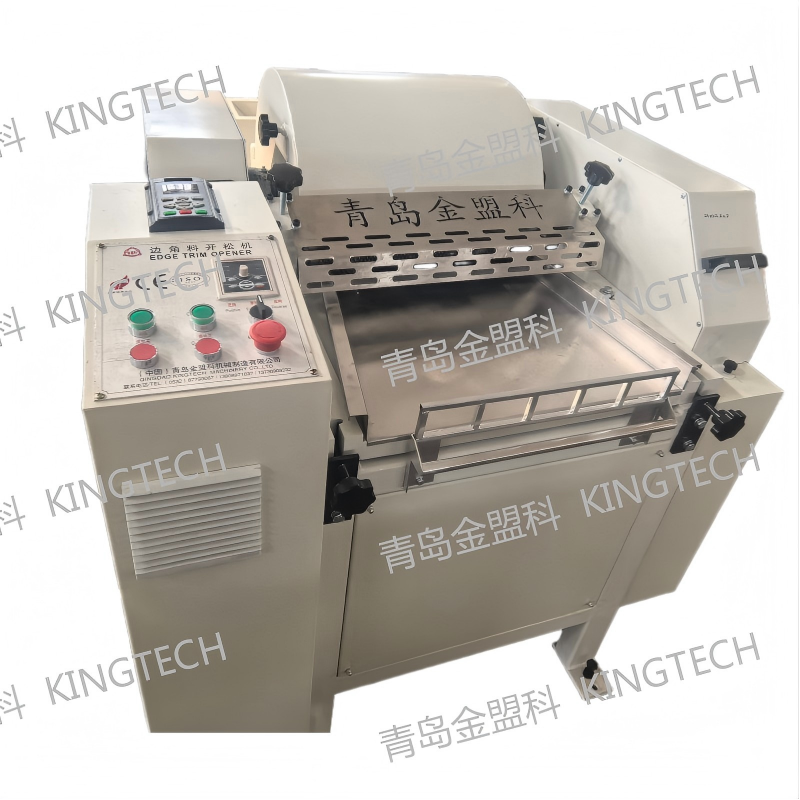
An Edge Trim Opener is designed to solve this problem by converting edge trim waste back into loose fiber form, allowing manufacturers to reuse materials inside their production systems. This process helps factories improve raw material efficiency, reduce waste loss, and build a more cost-effective production cycle without changing their core manufacturing structure.
Unlike traditional waste disposal methods, which treat trims as unusable output, this system redefines them as recoverable production input.
Why Edge Trim Waste Becomes a Continuous Cost in Nonwoven Production
In nonwoven manufacturing, trimming is not an occasional event but a continuous part of production. Every roll produced creates two side edges that are usually removed for quality consistency. When production runs at high speed for long hours, this waste accumulates into a significant material loss.
Many factories underestimate this loss because it is not always visible in final product output calculations.
Common cost contributors include continuous fiber loss during trimming operations, raw material inefficiency caused by discarded edges, disposal and handling expenses for industrial textile waste, and missed opportunities for fiber reuse inside the same production system.
Over time, these factors reduce overall production efficiency even if machine output remains stable.
How an Edge Trim Opener Reintegrates Waste into Production Flow
An Edge Trim Opener is not simply a cutting or shredding device. Its main purpose is to restore fiber usability from compact or layered edge trims. Instead of destroying the material, it applies controlled mechanical opening to separate fiber structures.
The recovered fiber can then be reused directly or blended with virgin material depending on production requirements.
The process generally involves feeding edge trim waste into the system, mechanically opening compact fiber layers, separating bonded structures into loose fiber form, stabilizing fiber consistency through controlled processing, and finally outputting reusable fiber material for reintegration.
This creates a material loop inside the factory rather than a linear waste stream.
Production Integration Methods in Industrial Environments
Edge Trim Openers can be integrated into nonwoven production systems in different ways depending on factory layout and production scale. Some manufacturers prefer direct inline integration, while others use offline centralized recycling systems.
In inline configurations, edge trim waste is collected and processed in real time, allowing continuous recycling back into production lines. This setup is commonly used in large-scale facilities where material flow stability is critical.
In offline configurations, waste is collected from multiple production lines and processed in batches. This method provides flexibility in handling different material types and production schedules.
Both approaches aim to reduce raw material loss but differ in operational structure and investment planning.
Importance of Fiber Preservation During Recycling
One of the most important technical aspects of edge trim recycling is maintaining fiber integrity. If the mechanical opening process is too aggressive, fibers may become shortened or damaged, reducing their usability in downstream applications.
High-quality Edge Trim Openers are designed to balance opening efficiency with fiber protection. This ensures that recovered fibers retain enough structural quality to be reused in nonwoven production or blended applications.
Key quality factors include controlled mechanical force during opening, stable fiber separation without excessive breakage, preservation of fiber length for industrial reuse, and consistent output quality across continuous operation.
Fiber quality directly determines whether recycling is economically valuable or only partially usable.
Industrial Applications of Recovered Edge Trim Fibers
Recovered fibers from edge trim processing can be used across multiple industries depending on quality grade and fiber type. These materials are not limited to low-end applications but are widely used in high-value industrial products.
Typical applications include automotive interior materials such as insulation layers and soundproofing components, hygiene and medical nonwoven products, sanitary absorbent materials, filtration systems for air and liquid processing, furniture filling and structural padding materials, and industrial felt or composite reinforcement layers.
This wide application range increases the economic value of recycled fibers and supports sustainable manufacturing practices.
System-Level Role in Modern Nonwoven Factories
Modern nonwoven factories are increasingly designed as integrated production systems rather than isolated machines. Within this structure, Edge Trim Openers act as a bridge between waste generation and material reuse.
They connect trimming processes with fiber recovery systems and help establish a semi-closed material loop inside production environments. This allows factories to treat waste not as an endpoint but as a recoverable resource within the same production cycle.
This system-level integration improves material efficiency, reduces waste handling complexity, and supports continuous production stability.
Future Development Direction of Edge Trim Recycling Technology
As industrial automation and smart manufacturing continue to evolve, edge trim recycling systems are also becoming more advanced. Future developments are focused on improving intelligence, energy efficiency, and system integration.
Emerging trends include real-time monitoring of waste flow, automated adjustment of opening intensity based on material density, energy-efficient mechanical designs to reduce operational cost, integration with factory digital management systems, and centralized recycling control across multiple production lines.
These advancements will further strengthen the role of recycling systems in modern industrial production.
Conclusion
An Edge Trim Opener plays a critical role in modern nonwoven manufacturing by transforming continuous production waste into reusable fiber resources. Instead of treating edge trims as disposable waste, manufacturers can integrate them back into production systems to improve material utilization and reduce overall production costs.
By enabling a circular material flow inside the factory, this equipment supports both economic efficiency and sustainable manufacturing goals. For nonwoven producers, it is not only a recycling solution but also a strategic tool for optimizing long-term production performance.
FAQ
1. What is the main purpose of an Edge Trim Opener?
Its main purpose is to convert nonwoven edge trim waste into reusable fiber that can be reintegrated into production systems.
2. Can recycled edge trim fibers be used directly in production?
Yes, depending on fiber quality, they can be reused directly or blended with virgin materials for manufacturing.
3. What is the difference between inline and offline recycling systems?
Inline systems process waste directly during production, while offline systems handle collected waste in separate batches.
4. Does edge trim recycling affect final product quality?
If properly controlled, recycled fibers can maintain stable quality and be safely used in many nonwoven and industrial applications.
Post time: Jun-16-2026